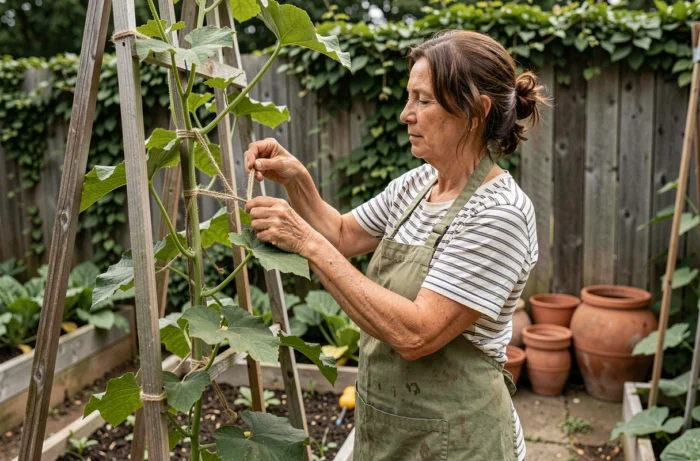
On a vegetable garden of less than twenty square meters, allowing a butternut squash to spread on the ground means sacrificing half of the surface area. Training this squash on a vertical support changes the game: you gain space for other crops, and the fruits grow under better sanitary conditions. However, it is essential to adapt the support and maintenance for a plant whose each fruit often weighs more than a kilogram at maturity.
Powdery mildew and air circulation: the health advantage of butternut training
The butternut is sensitive to powdery mildew, that white fluff that invades the leaves and eventually weakens the plant. On the ground, the dense and compact foliage retains moisture, which promotes the spread of the fungus.
In vertical cultivation, air circulates freely between the leaves, significantly reducing the pressure of powdery mildew. To enhance this effect, one can orient the trellis in the direction of the prevailing wind and prune the lower leaves that remain in the shade.
When training the butternut squash vertically, you also facilitate visual inspection of the stems and fruits. Spotting the beginning of an aphid attack or a suspicious spot takes just a few seconds, whereas it would require lifting meters of sprawling vines.
Rigid trellis for butternut squash: which support to choose
Nylon nets or simple bamboo stakes are not suitable. An adult butternut carries several heavy fruits on vines that pull down with force. A net that is too soft deforms, the stems break, and you find the squashes on the ground.
A rigid metal mesh panel is the most reliable support. Cattle grid or welded trellis panels provide the necessary strength. They do not bend under the load and allow light to pass through.
Trellis sizing and anchoring
The height of the support must allow the vines to climb at least one meter fifty. The supporting posts should be anchored in the ground to a sufficient depth so that they do not topple under the combined weight of the vegetation and fruits.
- Prefer treated wooden or galvanized metal posts, driven at least forty centimeters into the ground
- Secure the mesh panel with thick wire or zip ties, checking the tension after a few weeks of growth
- Provide diagonal bracing (strut) on supports taller than one meter fifty
Opinions vary on the necessity of doubling the panel when growing multiple plants side by side. With two butternut plants spaced one meter apart on the same trellis, a single panel is generally sufficient if the anchoring is solid.
Training butternut vertically: pruning, guiding, and supporting the fruits
Unlike climbing beans, the butternut does not spontaneously cling to the support. Its tendrils are short and do not always wrap around the mesh. You need to guide the stems manually, especially during the first few weeks.
Attach the vines to the trellis every twenty to thirty centimeters with soft ties (raffia, fabric strips, foam ties). Rigid ties can damage the bark and create entry points for diseases.
Support each fruit to prevent it from pulling off the stem
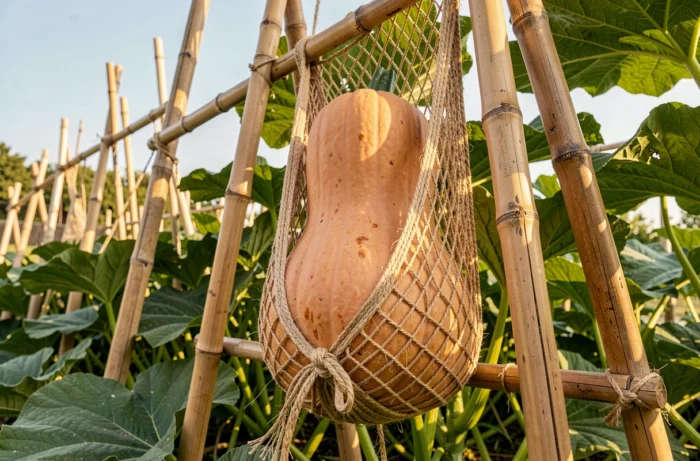
A butternut fruit that grows in suspension exerts a pull on the peduncle. Without support, the peduncle can snap or the stem can tear. You can make a support pouch with a piece of onion netting, an old pantyhose, or a lightweight fabric tied to the trellis mesh.
Each fruit should rest in its own pouch as soon as it reaches the size of a tennis ball. Waiting longer risks breakage.
Pruning secondary vines
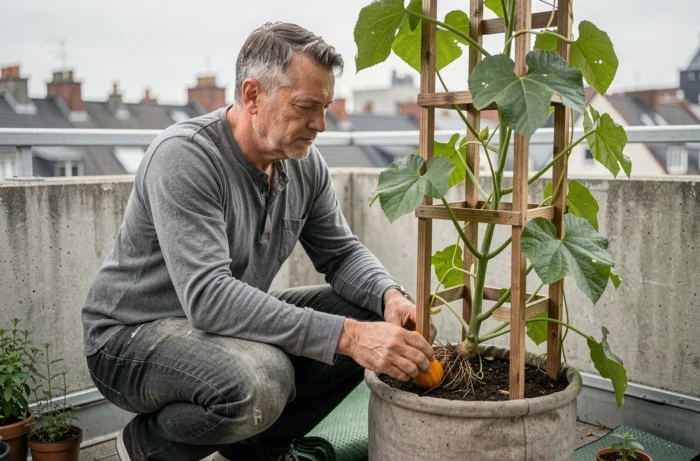
The butternut produces many branches. In vertical cultivation, secondary vines are limited to concentrate energy on two to three fruits per plant. Pinch the lateral stems after the second leaf, and remove the shoots that go off into the void without finding support.
This regular pruning keeps the foliage airy and prevents the trellis from turning into a compact mass of vegetation, which would negate the health benefits of training.
Sowing, soil, and watering for trained butternut
The butternut needs rich soil and regular watering, whether grown horizontally or vertically. However, training changes the management of water.
In a vertical position, the soil at the base of the trellis dries out faster because the foliage no longer covers the ground. A thick mulch (straw, dried grass clippings, wood chips) compensates for this evaporation and maintains the moisture that the roots need.
- Sow in pots indoors four to five weeks before the last frost, then transplant at the base of the trellis when the soil is warmed
- Space the plants at least eighty centimeters apart along the support
- Water at the base without wetting the foliage, preferably in the morning, to limit fungal development
- Add well-decomposed compost at planting, then an organic mulch about ten centimeters thick
The butternut is potassium-hungry during fruit formation. Adding wood ash or comfrey tea every two to three weeks supports fruiting without excess nitrogen, which would favor leaves at the expense of squashes.
Vertical training of butternut requires a bit more attention than traditional sprawling cultivation, especially for tying the vines and supporting the fruits. But in a small vegetable garden, it is the most practical way to harvest squashes without sacrificing space reserved for tomatoes, beans, or salads.