
Exploring cuisine means going beyond the repertoire of mastered recipes to question the very mechanics of taste perception. The combination of the five basic flavors (sweet, salty, sour, bitter, umami) is no longer sufficient to describe what we observe on restaurant menus or in food product formulation trends. Flavor profiles are becoming more complex, consumers are seeking overlaps (sweet-smoky-sour, spicy-fruity), and the palate is becoming a field for both technical and hedonistic experimentation.
Trigeminal perception and new flavors: what the taste buds do not capture
The tongue identifies five fundamental flavors through its taste receptors. Everything else, the cooling sensation of menthol, the burn of chili, the tingling of Sichuan pepper, falls under the trigeminal nerve and not the taste buds. This distinction radically changes the approach when trying to awaken the palate with new flavors.
The capsaicin in chili activates TRPV1 receptors, sensitive to heat. Menthol stimulates TRPM8 receptors, associated with cold. These two molecules do not produce any taste in the strict sense: they generate pain or a thermal sensation that the brain interprets as a component of the dish. Understanding this mechanism allows for precise dosing rather than adding chili “by feel.”
We recommend working with trigeminal sensations separately from the taste profile when developing a recipe. Adjusting the acidity of a sauce, then only afterwards introducing a spicy or refreshing element, avoids imbalances that the palate perceives vaguely without being able to name them.
To explore cuisine on Goûts et Passions, this logic of building by sensory layers is a good starting point before embarking on bolder combinations.

Spices and fermented ingredients: two complementary levers to awaken your taste buds
Spices bring volatile aromatic compounds. Fermented ingredients provide umami, acidity, and a depth that spices alone cannot produce. Combining these two families of ingredients multiplies the perceptible complexity without increasing the amount of salt or sugar.
Spices with complex aromatic profiles
Roasted cumin does not deliver the same molecules as raw cumin. Roasting releases pyrazines (toasted, earthy notes) absent from the raw product. The same principle applies to fenugreek, coriander seeds, and black pepper.
- Roasted fenugreek develops caramel and maple syrup aromas, usable in both savory and sweet preparations
- Coriander seeds, lightly crushed dry in a pan, shift from a lemony profile to a more woody and warm register
- Sichuan pepper, distinct from black pepper, produces a numbing sensation (the “má” effect) that alters the perception of all flavors present in the dish
We observe that many amateur cooks use ground spices directly from the jar. Roasting and grinding at the time of use significantly changes the aromatic density of the final result.
Fermentations and umami
Miso, soy sauce, nuoc-mâm, kimchi, and kombucha share a common point: fermentation generates free glutamate, the main vector of umami flavor. Incorporating a spoonful of white miso into a vinaigrette or deglazing a pan with a splash of nuoc-mâm are simple gestures that transform a familiar dish.
Garum, a fermented fish condiment used in ancient Rome, is making a comeback in professional kitchens. Chefs are producing it from shrimp, mushrooms, or even fermented coffee beans. This type of ingredient illustrates how fermentation opens a spectrum of flavors inaccessible through cooking alone.
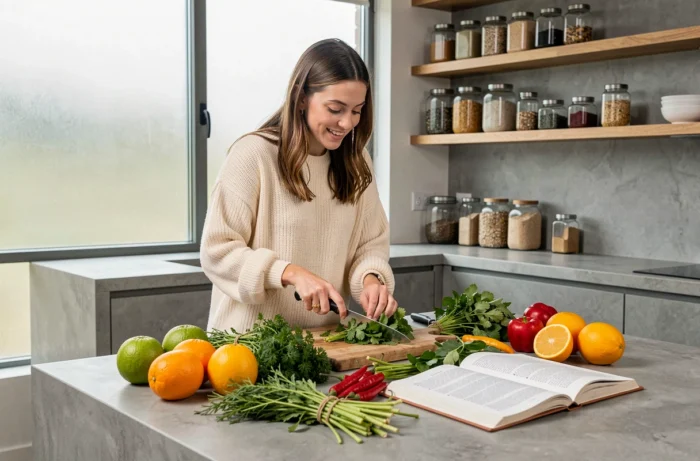
Complex aromatic profiles: building a dish in successive layers
A memorable dish layers at least three distinct aromatic registers. Thai and Mexican cuisines systematically apply this principle. A Thai green curry combines a fatty base (coconut milk), a spicy note (chili), a bright acidity (lime), an umami foundation (shrimp paste), and a herbaceous freshness (Thai basil, coriander). Each component occupies a different sensory “frequency.”
To replicate this logic with European ingredients, we recommend reasoning by families:
- Fatty base: brown butter, olive oil, cream, duck fat
- Acidity: sherry vinegar, verjus, citrus, homemade pickles
- Umami: grated parmesan, sun-dried tomatoes, anchovies, miso
- Spicy or fresh: mustard, horseradish, pepper, mint
- Subtle sweetness: caramelized onion, balsamic reduction, chestnut honey
A common mistake is to overload a single register. Three types of chili in the same dish do not add complexity; they saturate the trigeminal channel. Diversity of registers takes precedence over the intensity of a single one.
“Flavor tourists” trend: what the market reveals about our palates
An international study by Circana identifies a growing share of consumers it labels as “flavor tourists”. These profiles seek bold combinations in snacks and sweet products: sweet-smoky-sour associations, flavors inspired by cities like Dubai or Tokyo in premium chocolates.
This trend is also reflected in a recent increase in sweet snacks at the expense of savory snacks in Europe, Australia, and the United States. Sweet no longer means “simple”: consumers expect layered flavors in a brownie or cookie just as much as in a restaurant dish.
At the same time, the Consumer Observatory of EIT Food shows that the declared openness to innovative food products in Europe has risen from 28% in 2024 to 31% in 2025. Trust in the food system plays a crucial role: 38% of confident consumers say they are willing to try innovative products, compared to only 6% among those who express low confidence.
These data confirm that culinary exploration is no longer limited to a hobby for enthusiasts. It is now structuring the formulation strategies of the food industry and chefs’ menus. Awakening the palate has become a measurable consumption behavior, not just a vague aspiration.