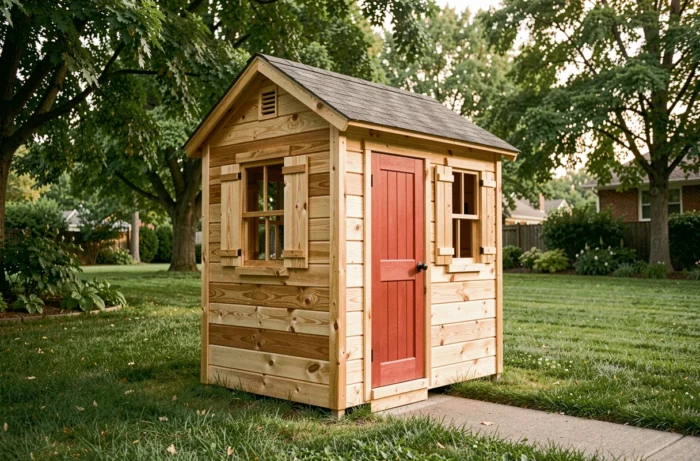
Before installing a wooden playhouse in the garden, several technical parameters need to be measured. Available ground area, type of wood, applicable safety standards, platform height: these criteria are not all equal depending on the age of your children. Comparing the characteristics of Brico Dépôt wooden playhouses helps identify the model that will last over time without compromising safety.
Safety standards for wooden playhouses: what regulations require
Competitors rarely address regulatory issues in detail. Any playhouse sold as a toy in Europe must comply with the Toy Safety Directive and the EN 71 standards (mechanical resistance, flammability, migration of chemical substances), with CE marking and recommended age range.
As soon as a model includes a high platform or elevated sleeping area, the NF EN 747 standard comes into play. It applies when the sleeping height exceeds 60 cm, with mandatory guardrails and a minimum age set at 6 years. This is a point to systematically check on the raised playhouses offered in DIY superstores.
Before finalizing your purchase, check for the presence of the CE marking on the packaging and the explicit mention of the age range. To choose a suitable Brico Dépôt wooden playhouse, this verification serves as the first filter even before looking at dimensions or price.
Ground area and height: comparative table by age range
The area of the playhouse determines both the comfort of play and the footprint in your garden. Here is a guideline by age range, based on the size categories found in DIY catalogs.
| Age Range | Recommended Usable Area | Indicative Ridge Height | Suitable Model Type |
|---|---|---|---|
| 2-4 years | Less than 2 m² | Less than 1.30 m | Ground-level playhouse, without platform |
| 4-7 years | Between 2 and 4 m² | About 1.40 to 1.60 m | Ground-level or low raised playhouse |
| 7 years and older | More than 4 m² | More than 1.60 m | Raised, with accessories (slide, sandbox) |
Playhouses of less than 2 m² are suitable for toddlers, but their usage duration remains short. A model between 3 and 5 m² offers the best compromise between reasonable footprint and longevity of use.
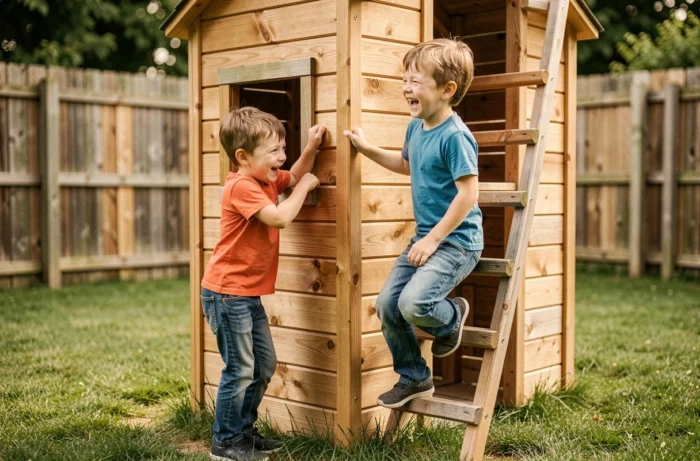
Also, consider the rule of 2 meters of clearance around the structure, as highlighted in safety recommendations for private play areas. This buffer zone prevents collisions during entries and exits.
Pressure-treated wood or untreated wood: what treatment for a durable children’s playhouse
The choice of wood directly affects the maintenance and lifespan of the construction. Two main options are found in playhouses sold at DIY stores.
- Pressure-treated wood is treated through pressure impregnation. Its use class depends on exposure: class 3 for above-ground use, class 4 for ground contact. This treatment ensures long-lasting protection without annual maintenance.
- Untreated wood (natural pine) is cheaper to purchase but requires staining or saturating every year to withstand humidity and UV rays.
- Cedar, naturally rot-resistant, is an alternative without chemical treatment. However, it is rarely found in Brico Dépôt catalogs and is positioned in a higher price segment.
For a playhouse intended for young children, the issue of chemical substances is important. Recent content on wooden toys emphasizes the importance of non-toxic paints and stains compliant with EN 71 standards, which regulate the migration of chemical substances. Ensure that the manufacturer explicitly mentions this compliance.
Maintenance according to wood type
Pressure-treated wood class 3 only requires annual cleaning with water and mild soap. Untreated wood, on the other hand, requires light sanding followed by a coat of stain every spring. Over time, the initial price difference between the two options quickly diminishes when factoring in maintenance product costs and time spent.
Accessories and construction: criteria that extend lifespan
Integrated accessories (slide, sandbox, outdoor kitchen, telescope) determine the perceived lifespan of the playhouse much more than the model itself. A child with various play elements around the cabin uses it longer than with a simple closed structure.
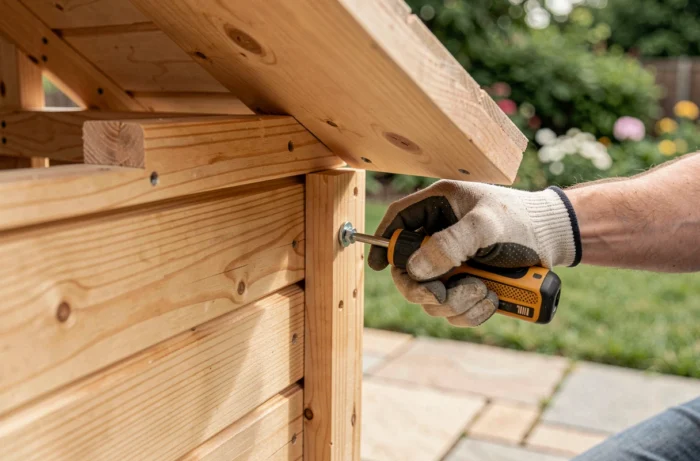
When comparing references, also assess the quality of the assembly kit. Some models offered in DIY superstores include pre-drilled panels and a complete set of screws. Others require additional tools (saw, drill-driver) and a significantly longer construction time.
- Check that the assembly plans are provided in French, with dimensioned diagrams and a numbered parts list
- Prefer models with an integrated floor, which insulates the structure from ground moisture
- Check the thickness of the wood panels: a panel that is too thin will warp after a few seasons
Interior storage is often an overlooked detail. A playhouse equipped with shelves or integrated bins facilitates ownership by the child and limits wear and tear due to clutter.
Budget and value for money in DIY stores
Wooden playhouses sold in DIY stores cover a wide price spectrum. Ground-level models in untreated pine are at the lower end of the range. Structures on stilts with slides and accessories reach significantly higher amounts. The most discriminating variable remains the type of wood and the level of treatment included.
Comparing technical characteristics (wood thickness, use class, usable area, accessories) rather than just the displayed price provides a more reliable assessment of the actual value for money.
The criterion that weighs most in long-term satisfaction remains the suitability between the playhouse area and the age of the children. A structure that is too small will be abandoned in less than two seasons. It is better to invest in a slightly larger area than the immediate need than to buy a larger model three years later.