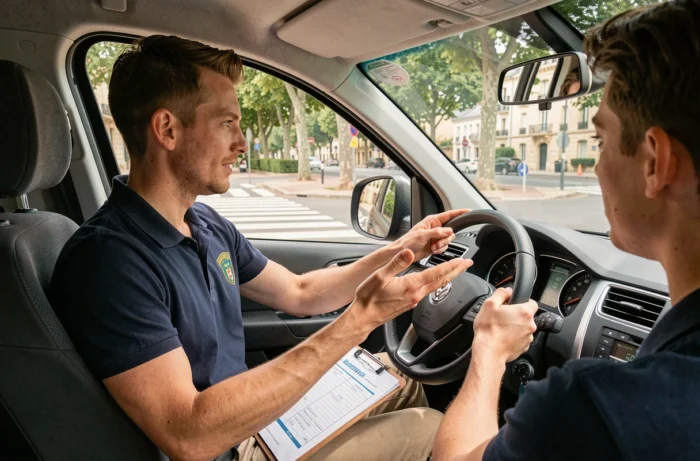
How much time, how much money, and what administrative conditions separate a candidate from the profession of driving instructor? The path to becoming a driving school instructor in France is based on a unique diploma (the ECSR professional title), a prefectural authorization, and several eligibility criteria that deserve comparison before committing.
Professionalization contract and ECSR TP: two pathways to the instructor profession
Most guides describe a linear path: finance training, obtain the diploma, then look for a job. The reality of the market opens a more direct alternative.
Recent job offers published on France Travail show that a driving school can recruit a candidate without an ECSR diploma or prior experience through a professionalization contract. The candidate prepares for the professional title while working, with the only condition being that they have completed their probationary period for the B license.
This pathway presents a net financial advantage: the training is covered by the employer and the OPCO, and the candidate receives a salary throughout the duration of the contract. For those who wish to consult the website www 1 Emploi, the job sheets detail the prerequisites according to the chosen access mode.
On the other hand, the classic path through an accredited training center remains the norm. It is aimed at those who prefer to obtain the diploma before positioning themselves in the job market.
| Criterion | Classic Training (accredited center) | Professionalization Contract |
|---|---|---|
| Cost for the candidate | Between 8,000 and 10,000 euros | Covered by the employer/OPCO |
| Remuneration during training | None (except for aids like CPF, Pôle emploi) | Salary paid during the contract |
| Diploma required at entry | No specific diploma | No specific diploma |
| B license condition | Valid B license | Probationary period completed |
| Average duration | About 9 to 12 months | Variable depending on the contract |
| Guaranteed hiring | No | Objective of sustainable hiring |
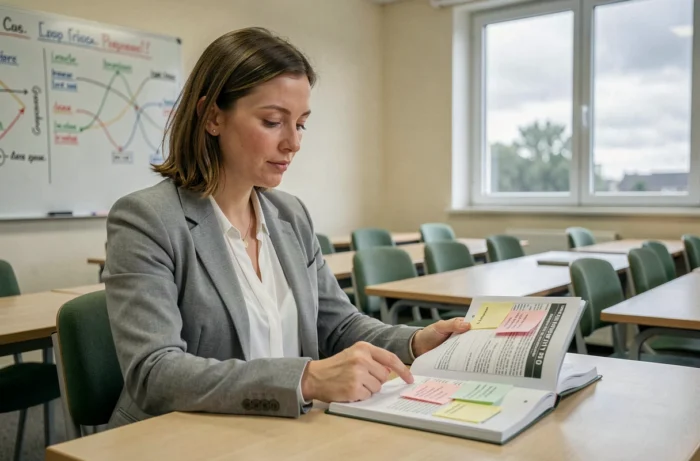
ECSR Professional Title: Exam Structure and CCP to Validate
The ECSR professional title (Driving and Road Safety Instructor) has replaced the former BEPECASER. It is classified at the bachelor’s level +2 in the diploma nomenclature and consists of two distinct certificates of professional competence.
CCP 1: Training Driver Learners
This first block covers practical driving instruction. The candidate must demonstrate their ability to conduct an individual session in a vehicle, assess a student’s progress, and adapt their teaching methods to various profiles.
CCP 2: Raising Awareness of Road Safety
The second block focuses on conducting group sessions. It involves designing and leading awareness-raising activities for diverse audiences, beyond just the driving school context.
Both CCPs must be validated to obtain the title. A candidate who fails one of the two can retake it later without having to redo the entire training, which limits financial risk in case of partial failure.
Authorization to Teach Driving: Prefectural Process and Renewal
Obtaining the ECSR TP is not enough to legally practice. Each instructor must hold a teaching authorization issued by the prefecture, which is the real administrative key to the profession.
The conditions to be met for this authorization are cumulative:
- Hold the ECSR professional title (or a recognized equivalent diploma)
- Have a criminal record compatible with the practice of the profession (bulletin n°2 free of certain convictions)
- Have undergone a medical examination by a doctor approved by the prefecture, with a positive opinion
- Hold a valid B license
This authorization is free but limited to five years. Its renewal requires retaking the medical examination and proving the validity of the license. A failure to renew completely prohibits practice, even for an experienced instructor.
Shortage of Driving School Instructors: What France Travail Data Reveals
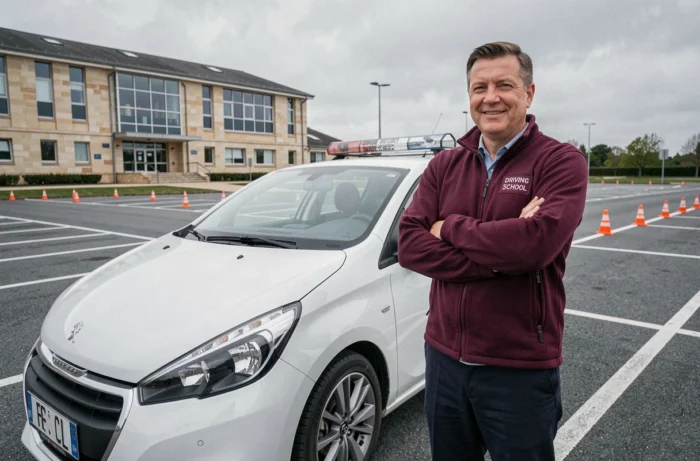
The profession of driving instructor is among those with structural and national shortages in 2026, according to BMO data from France Travail. A significant portion of the positions offered each year remains unfilled due to a lack of qualified candidates.
For a beginner freshly holding the ECSR TP, this market tension translates into quick access to employment. Driving schools are recruiting in all regions, including rural areas where the deficit is particularly pronounced.
Conversely, this shortage creates an unusual salary negotiation lever for a profession accessible without a university diploma. Candidates who hold both CCP 1 and CCP 2 with a specialization in motorcycles or heavy goods vehicles find themselves in an even more favorable position.
Driving School Operator: Distinct Requirements from Employee Instructors
Teaching driving and managing a driving school are two separately regulated functions. To open an establishment, the conditions are significantly more stringent:
- Be at least 23 years old
- Have held a B license for at least 3 years
- Possess a diploma at the bachelor’s level +2 or the RUESCR certification (management of driving instruction establishments)
- Obtain a prefectural operating approval, distinct from the teaching authorization
An employee instructor does not need the management diploma or the operating approval. These obligations only concern the head of the establishment. Confusion between the two statuses is common and leads some candidates to overestimate the prerequisites necessary to simply teach.
The choice between being an employee or starting a business thus depends as much on the administrative profile as on professional ambition. An instructor who wishes to remain a trainer has no reason to aim for the operating approval, while a future operator will need to anticipate additional steps from the outset of their project.