
A thermal brush cutter is primarily chosen based on the type of vegetation cover to be treated and the regulatory constraints of the land, not on the price or the color of the hood. Here we detail the technical criteria that distinguish an appropriate machine from a regrettable purchase right from the first season.
Engine displacement and architecture: what determines the actual cutting capacity
Displacement remains the first indicator of a thermal brush cutter’s ability to maintain its speed under load. Below 25 cm³, the machine is suitable for soft grasses and edge finishing. Above 40 cm³, we enter the territory of thick brambles, woody shoots, and structural clearing imposed by the legal obligation to clear.
A 2-stroke engine still dominates the market for thermal brush cutters, for a simple reason: a favorable power-to-weight ratio and simplified mechanics. 4-stroke engines (or 4-MIX from Stihl) provide a more consistent torque at low speeds and reduced consumption, but add weight and maintenance complexity. We recommend the 4-stroke only for long sessions on mixed vegetation, where constant torque prevents overloading the cutting head.
One point that consumer guides overlook: load stratification. Recent engines with stratified scavenging reduce the amount of fresh mixture ejected into the exhaust. The gain is measured in autonomy (less fuel wasted) and compliance with emission thresholds. Before purchasing, check if the engine incorporates this technology; we find a detailed comparison on top-debroussailleuse-thermique.com that ranks models by engine architecture.
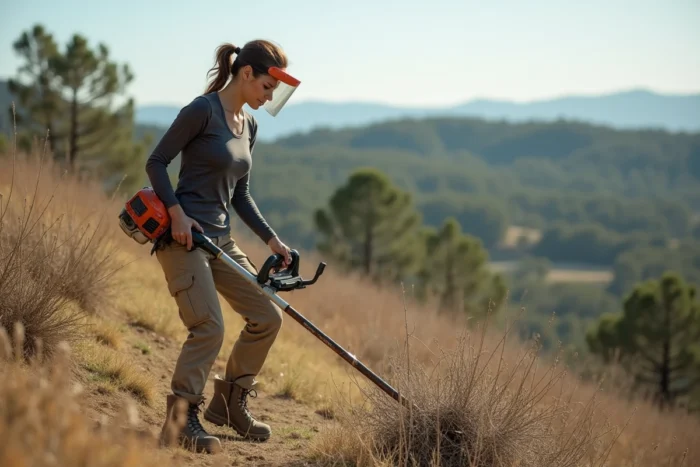
Legal obligation to clear: choosing your machine according to the Forestry Code
Since the law of July 10, 2023, and the decree of March 29, 2024, the framework for the legal obligation to clear (OLD) has been strengthened with harmonized technical requirements at the national level. The machine must be able to ensure the break in continuity of the vegetation cover, pruning and removing cuttings, not just mowing the grass.
Specifically, if your land is located in a department subject to the OLD (expanded perimeter in 2026), a low-displacement brush cutter with a simple nylon line will not be sufficient to meet the prefectural requirements. A machine capable of accepting a three-tooth blade or a brush disc to cut woody shoots and low shrubs is needed.
Sanctions for non-compliance with OLD work are becoming stricter. Choosing a thermal brush cutter suitable for these obligations protects both the land and the wallet. We observe that many individuals purchase an undersized model, then invest in a second device the following year.
Cutting system: nylon line, blade or disc depending on target vegetation
The cutting system directly determines what the machine can fell. Three configurations dominate:
- The nylon line (round or square, 2 to 3 mm in diameter) is suitable for tall, soft grasses. A square line cuts better than a round line on dense grasses but wears out faster when in contact with stones or stumps.
- The 3-tooth steel blade tackles brambles, woody nettles, and young shrub shoots. It requires a safety harness and an appropriate blade guard.
- The brush disc (circular saw type with carbide teeth) cuts branches up to several centimeters in diameter. Reserved for machines over 35 cm³ with a rigid drive shaft.
Versatility relies on the compatibility of the cutting head. Some models accept all three configurations without an adapter, while others require a specific kit. Check the diameter of the shaft and the type of attachment before purchasing.
Ergonomics and harness: comfort criteria on rough terrain
The weight of a thermal brush cutter varies significantly depending on the displacement and chassis design. On sloped or rough terrain, a poorly adjusted harness turns a clearing session into a physical ordeal.
A double strap harness with a lumbar belt distributes the load across the torso rather than just the shoulders. Professional models from Stihl or Husqvarna incorporate a quick-release system, useful in case the blade gets stuck in a stump.
Two other points deserve attention:
- The type of handle: a U-shaped handle (or “bicycle”) offers better control for wide sweeping on flat terrain, while a D-handle allows for vertical movements in dense underbrush.
- The anti-vibration system: the silent blocks between the engine and the drive tube reduce fatigue in the hands and forearms. During sessions longer than an hour, this difference becomes a determining choice criterion.
Thermal engine maintenance: anticipating common breakdowns
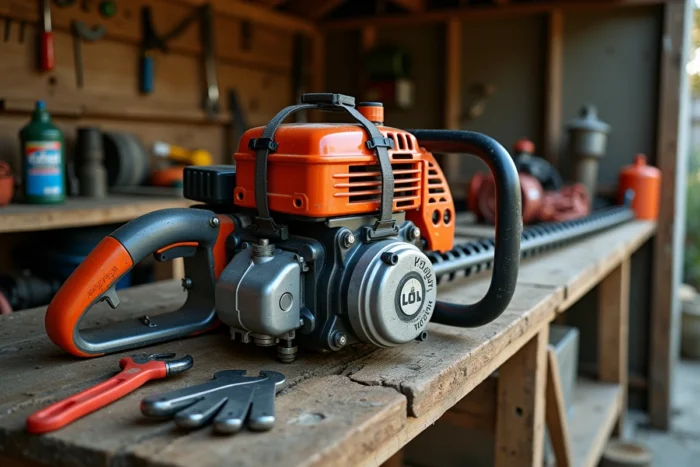
A thermal brush cutter that stalls after a few minutes almost always suffers from the same problem: a clogged carburetor due to a mixture stored too long. Draining the tank at the end of the season prevents most starting failures in spring.
The air filter should be inspected every five to ten hours of use. On a 2-stroke engine, a clogged filter enriches the mixture, fouls the spark plug, and reduces power. The spark plug itself should be replaced at the beginning of each season with regular use.
The drive shaft (rigid or flexible) requires periodic greasing at the angle drive. A dry angle drive generates a characteristic metallic noise and eventually seizes, leading to costly repairs. A few seconds of lithium grease are enough to extend the lifespan of this part by several seasons.
The choice of a thermal brush cutter depends on the compatibility between the engine displacement, the cutting system, and the actual nature of the terrain. The new clearing obligations require machines capable of handling woody vegetation, not just soft grass. It is better to invest in a slightly oversized model than to buy a new device the following year.