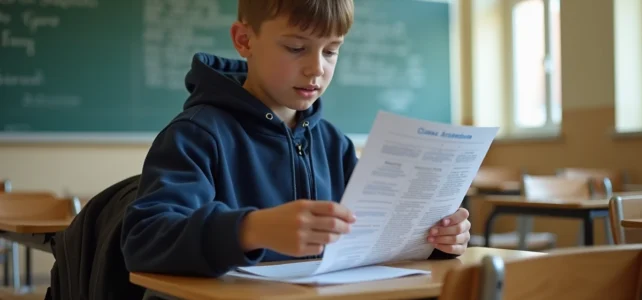
A parent receives the information sheet from the school at the end of June, fills it out in five minutes, and forgets about it. However, this document conditions part of the organization of schooling for the following year: emergency contacts, dietary requirements, permission for outings, choice of foreign languages. For the 2026 school year, several adjustments in programs and class sizes change what is expected from this class sheet. It’s better to know where to look before checking the boxes.
Information Sheet 2026: The Sections That Really Cause Problems
The school information sheet remains a paper or digital form distributed by the middle school, usually between the end of June and the beginning of July. It includes the student’s identity, the contact details of legal guardians, family situation, medical information, and various permissions.
The issue is that many families fill out this document automatically without checking the details. However, an error in emergency contacts delays any intervention in case of a problem. If a phone number has changed, if shared custody has evolved, if an IEP (Individualized Education Plan) needs to be updated: this is the sheet that the administration relies on, not informal exchanges with the homeroom teacher.
For the 2026 school year, it is noted that schools are increasingly requesting a valid email address for each legal guardian, as report cards, invitations to class councils, and notifications of orientation are now transmitted through digital platforms. If one wants to understand the class sheet 2026 in its entirety, it is necessary to integrate that this form is no longer just an administrative paper but the entry point for all school-family communication.

New Programs and Financial Education in Middle School in 2026
Competitors say little about the educational content coming into the classrooms. Yet, this directly impacts the daily lives of middle school students.
The back-to-school circular for 2026 emphasizes the consolidation of ongoing reforms, not new restructurings. In practice, this means that new programs are gradually coming into effect from kindergarten to middle school. For 8th and 9th graders, one concrete point deserves attention: financial education is making its appearance in the school curriculum, with an announced extension to general and technological high schools starting in 2027.
This program covers money management, payment methods, the concept of budgeting, and financial risks. For parents, this means that the child may have assignments or projects related to these themes. A new skill, absent from previous programs, which may surprise if not spotted in the liaison sheet or the correspondence notebook.
Diploma and Evaluation: What Matters on the Progress Sheet
The diploma remains the main deadline for 9th graders. The class sheet, in a broad sense, also includes the tracking of the orientation pathway (Avenir pathway) and evaluations of the common core. Each skill validated by the class council weighs in the final calculation.
The evaluations from the class council directly feed into the orientation file for high school. A student aiming for a general 10th grade or a specific vocational high school has an interest in ensuring that their wishes are correctly recorded. Feedback varies on this point among schools: some middle schools allow families to validate online, while others require a signed paper form.
Class Sizes for the 2026 School Year: A Tense Variable
In several academies, alerts are being raised regarding demographic pressure linked to births in recent years. Without the opening of additional divisions, some middle schools risk having larger classes starting September 2026.
In practical terms, this changes the situation for families on several points:
- Requests for exceptions to change schools will be more difficult to obtain if the local middle schools are full.
- Small group classes (in foreign languages or sciences) will not be guaranteed everywhere, depending on the resources allocated to each school.
- Students benefiting from a PAP (Personalized Support Plan) or a PPRE (Personalized Educational Success Program) may see their individualized support weakened in large classes.
The ministry has stated that there are enough teachers for the 2026 school year. The issue is not only about recruitment but also about the distribution of positions among academies and schools.
Online Scams Regarding the Composition of Classes 2026
Every year, websites claim to reveal the composition of classes in advance. For the 2026 school year, the phenomenon persists. No external site can access class lists before their official display by the school, usually on the day of the start of school or the day before.
The rule is simple: the lists remain confidential until the decision of the school principal. Platforms that ask for a phone number, payment, or personal data in exchange for this information are scams. These sites should be reported via the official reporting platform (internet-signalement.gouv.fr), without clicking on the links provided.
What Parents Can Legitimately Request
It is entirely possible to contact the school to make a request regarding their child’s class. Bringing two students together, separating a duo that causes difficulties, reporting a conflict: the school principal remains the decision-maker, but takes into account well-argued requests.
This process involves sending a letter or email to the administration, ideally before mid-July. Late requests (end of August) are unlikely to succeed, as class assignments are already finalized.
For the 2026 school year, checking the information sheet, following the new skills in the program, and anticipating class size constraints remains the trio of the most useful actions. The rest, the exact composition of the class, the name of the homeroom teacher, will be revealed at the start of the school year, as every year.