
The payment for a facade renovation follows specific rules, especially in co-ownership. Between the vote in the general assembly, the distribution of charges, and recent legal obligations, each step of the financing deserves to be understood before committing. Misjudging the payment schedule or ignoring certain regulatory constraints can be costly, literally.
Thermal insulation obligation and impact on the renovation budget
One point that most co-owners discover too late: a facade renovation can trigger a legal obligation for thermal insulation. According to Opera Énergie, this constraint applies when the renovation concerns at least 50% of the facade excluding openings of a heated building.
In practical terms, the project is no longer limited to cleaning and plastering. It is necessary to integrate external insulation in the renovated areas, which radically changes the total amount to be financed. Exceptions exist for buildings sensitive to humidity or located in remarkable heritage sites, but they remain the exception.
This obligation changes the very nature of the vote in the general assembly. The property manager must present quotes that include the insulation aspect, and the co-owners vote on a global budget that is higher than initially expected. As detailed in the Smart PAP guide, payment is then organized according to this expanded scope.

Vote in the general assembly and calls for funds in co-ownership
The facade renovation is part of the works voted in the general assembly by absolute majority (Article 25 of the law of July 10, 1965). The property manager submits several competing quotes, and the co-owners express their opinions on each before selecting a company.
Recent case law reinforces this requirement. Between 2023 and 2026, several decisions by the Court of Cassation confirmed that a property manager who undertakes work without the express authorization of the general assembly incurs personal liability. A second vote on a new quote is only possible after reviewing each competing offer during the first assembly.
Schedule of calls for funds
Once the vote is secured, the property manager issues staggered calls for funds according to the progress of the project. Payment is not made all at once. Each co-owner receives a call proportional to their share of charges, usually in two or three installments.
- A first call for funds occurs before the start of the work, often amounting to one-third of the total voted amount
- A second call accompanies the main phase of the project (cleaning, repair, plastering)
- The balance is called upon completion of the work, after verifying their compliance
This splitting protects the co-ownership’s cash flow but requires each co-owner to anticipate these deadlines.
Defaulting co-owner: consequences and recourse for the property manager
The refusal or inability of a co-owner to pay their calls for funds does not block the project but creates a debt owed to the syndicate. A co-owner must pay even if they voted against the renovation. The majority vote binds all lots.
The property manager has several levers to recover unpaid amounts. A formal notice by registered letter opens a limitation period. Beyond that, a legal procedure can lead to an order to pay, or even a legal mortgage on the debtor’s lot.
For fragile co-ownerships, the accumulation of unpaid amounts for a renovation can destabilize the entire financial management. A regularly funded works reserve (made mandatory for co-ownerships over ten years old by the ALUR law) helps to cushion the shock.
Financing the renovation: collective loan and energy renovation aids
When the amount exceeds the co-ownership’s self-financing capacity, the property manager can negotiate a collective loan taken out in the name of the syndicate. Each co-owner then chooses to join it or to pay their share in cash. This mechanism avoids placing the financing burden solely on the residents’ own funds.
Available aids to reduce the bill
The obligation for thermal insulation during the renovation opens access to financing mechanisms related to energy renovation. The aids vary according to location, the nature of the building, and the occupants’ income.
- MaPrimeRénov’ Copropriétés finances part of the insulation work carried out as part of a renovation, subject to energy gain conditions
- Energy savings certificates (CEE) allow for obtaining bonuses paid by energy suppliers
- Some local authorities offer additional grants, particularly in areas subject to renovation orders
The combination of these aids can significantly reduce the remaining charge per co-owner, provided that the applications are submitted before the start of the project. A file submitted after the work begins is generally inadmissible.
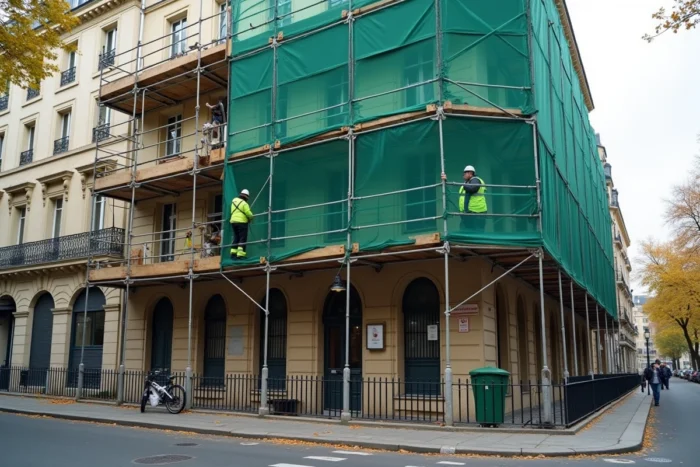
Distribution of charges between owner and tenant
The facade renovation is a charge for the owner, not the tenant. The landlord cannot pass on the cost of the renovation to the rental charges, even partially. The recoverable charges from the tenant cover routine maintenance (cleaning of common areas, cold water, elevator), not major repairs.
However, if the renovation includes thermal insulation, the landlord may, under certain conditions, request a contribution from the tenant for the share of energy savings. This mechanism remains regulated and requires demonstrated energy gain.
The multi-year works plan, now mandatory for co-ownerships over fifteen years old (and gradually extended to smaller ones since January 2025), allows for scheduling the renovation over several years and adapting the provisions accordingly. This anticipation remains the most effective lever to avoid sudden calls for funds and payment conflicts between co-owners.