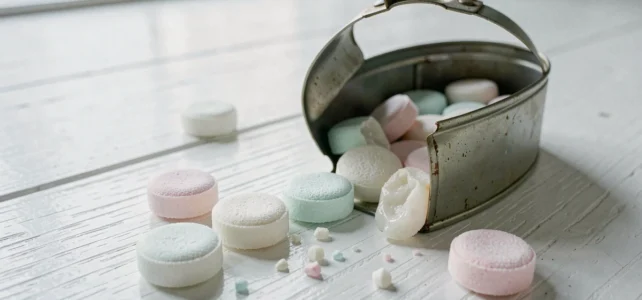
The Vichy pastilles look like ordinary candies, but their composition clearly distinguishes them from classic confections. Their main ingredient, sodium bicarbonate, makes it a product whose consumption should be measured, particularly among younger individuals. What fraction of a child’s daily sodium intake does a handful of these octagonal pastilles represent?
Sodium per Vichy pastille: the thresholds that matter for children
The sodium contained in each pastille is the starting point for any risk assessment. A pastille weighs about 2.5 g and contains between 80 and 100 mg of sodium. This figure seems low in isolation, but it takes on a different dimension when compared to a child’s needs.
| Profile | Recommended max sodium intake/day | Equivalent in Vichy pastilles (upper range) |
|---|---|---|
| Healthy adult | 2,000 mg (WHO) | 20 to 25 pastilles |
| Hypertensive adult or low-salt diet | Significantly less than 2,000 mg | Less than 10 pastilles |
| Child (lower needs, narrow safety margin) | Significantly less than an adult | A few pastilles can weigh heavily |
In children, sodium needs are lower and the safety margin is narrower than in adults. Five or six pastilles can represent a significant fraction of a child’s maximum daily sodium intake. Existing guidelines set the reasonable dose at four to six pastilles per day for a healthy adult, without ever recalculating this threshold for a smaller organism.
A child who snacks on these pastilles like candies, without supervision, can accumulate sodium well beyond what their metabolism can comfortably handle. Excess sodium is associated with water retention and, in the long term, an increased risk of high blood pressure.
To delve deeper into the topic of the dangers of Vichy pastilles for children, several physiological parameters come into play beyond just sodium.
Sugar and repetition: the effect of Vichy pastilles on children’s teeth
Sodium is not the only component to monitor. Vichy pastilles contain sugar, and their format encourages repeated consumption throughout the day. It is precisely this pattern that poses a problem for oral health.
Sweet forms taken multiple times a day are the most harmful to enamel. It is not the total amount of sugar ingested in a day that determines the caries risk, but the frequency of intake. Each pastille triggers an acid attack on the enamel, and if the child consumes one every half hour, saliva does not have time to restore a neutral pH between exposures.
Recent sources in dental pharmacology remind us that syrups, throat pastilles, and sweet granules taken repeatedly are among the most detrimental products for children’s teeth. Vichy pastilles, often perceived as harmless, fall into this category.
- Each sweet intake generates a drop in oral pH for twenty to thirty minutes, promoting enamel demineralization
- A child sucking on three or four pastilles spread over the afternoon subjects their teeth to as many distinct acid attacks
- The solid format prolongs the contact time between sugar and teeth, unlike a food swallowed quickly
The caries risk depends more on frequency than on the total dose of sugar. Two pastilles taken at the same time after a meal are less problematic than four pastilles spread throughout the day.
Sodium bicarbonate and digestion: a false friend for young organisms
Sodium bicarbonate gives Vichy pastilles their reputation as a digestive product. In adults, it temporarily neutralizes gastric acidity. In children, the situation is different.
A child’s digestive system is more sensitive to pH variations. Regular intake of sodium bicarbonate can disrupt the acid-base balance of the stomach, with counterproductive effects: bloating, discomfort, or even a rebound acidity effect when the neutralization stops.
Sodium bicarbonate is not a trivial product for children, even though it is sold over the counter in candy form. Medications containing sodium bicarbonate are, in fact, subject to specific precautions for use in pediatric populations.
Vichy pastilles are not a medication, but their active principle is the same as that of certain pharmaceutical specialties indicated for gastric disorders. This ambiguity between candy and digestive product clouds parents’ perception of risk.
Classic or mint Vichy pastilles: does composition change the risk?
Vichy pastilles come in several versions: plain, mint, lemon, fruit. The base remains the same (sodium bicarbonate, sugar, mineral salts from Vichy water), but do the added flavors change the risk profile?
The sodium and sugar content remains comparable from one version to another. The flavored variants are neither more nor less concentrated in bicarbonate. However, the menthol or lemon versions may encourage children to consume more, as the taste is more appealing than that of the plain pastille.
- The plain pastilles retain a slightly salty taste that naturally limits consumption among children
- The mint or lemon versions, closer to a classic candy in taste, encourage repeated consumption
- No version eliminates sodium or sugar: the underlying risk persists regardless of the flavor
The choice of variant does not therefore mitigate the risks associated with sodium or dental health. It masks them behind a more appealing taste.
What parents can take away about Vichy pastilles
Vichy pastilles are not toxic. They become problematic when a child consumes them without limit, like any other candy, while their sodium content places them in a separate category. Limiting intake to one or two pastilles per day for a child keeps sodium, dental, and digestive concerns within a comfortable zone.
The perception of these pastilles as a healthy product, linked to their thermal history and image as a digestive remedy, contributes to a relaxation of parental vigilance that their composition does not justify.