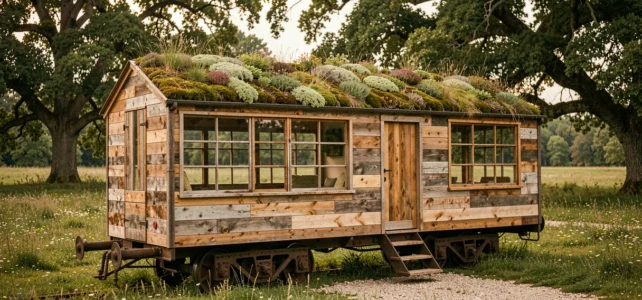
A freight or passenger car, abandoned on a siding for decades, does not resemble a future home. Its rusty steel shell, frozen axles, and warped floor do not inspire domesticity. However, transforming an old car into an eco-friendly house attracts new project holders in France every year, halfway between industrial reuse and alternative housing.
Thermal insulation of a car: the project that no one details
The steel of a car conducts cold and heat much faster than wood or brick. Without treatment, the metal wall generates condensation as soon as the indoor temperature exceeds that of the outside. Therefore, the first task for a successful conversion is insulation, and it is also the most technical.
Why does this point deserve so much attention? Because a lack of insulation in a metal structure does not forgive. Humidity settles between the wall and the insulation, promoting mold and degrading the metal from the inside.
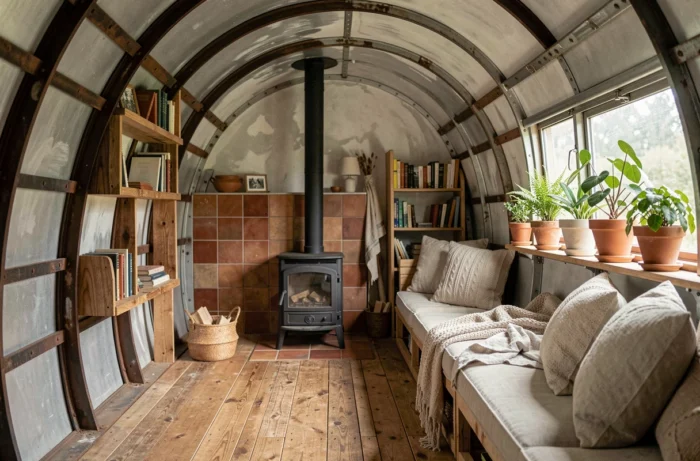
The most common solution is to create an internal wooden frame, detached by a few centimeters from the steel wall, and then to inject a bio-sourced insulation (wood wool, cellulose wadding, hemp fiber). This air gap between the metal and the wooden frame acts as a thermal break that prevents cold bridging. The interior walls are then covered with wood panels or breathable sheets.
The roof of the car, often curved, poses an additional problem: the curvature complicates the installation of rigid panels. Some projects opt for external over-insulation with a ventilated steel sheet roof, which also protects the original shell from the elements.
Concrete examples of these techniques can be found in a file dedicated to the converted car as a house on Vènerie Immo, which details several successful conversions.
Legal status of habitable cars in France
Do you think it’s enough to place a car on your land to live in it? French law has its say, and the rules have significantly evolved in recent years.
Since the ALUR law and its implementing texts, the Urban Planning Code recognizes a specific status: the demountable residence constituting permanent habitat. To qualify, the housing must meet several specific criteria:
- Be built with lightweight materials, without hard foundations (a car placed on sleepers or blocks meets this condition).
- Be able to be dismantled or moved without the use of heavy construction equipment, which excludes structures welded to a concrete slab.
- Have autonomy in water, sanitation, and energy, or be connected to public networks.
Depending on the floor area and the nature of the project, the administrative process varies: prior declaration for small areas, planning permission beyond that. The local urban planning plan (PLU) of the municipality may also restrict or prohibit this type of installation in certain areas.
Decorative car or construction subject to RE2020
The boundary between a car placed in a garden as a leisure shelter and a true habitable dwelling is not just a matter of comfort. The gradually extended environmental regulation RE2020 can apply as soon as the car is declared as permanent housing. This implies requirements regarding the thermal performance of walls, energy consumption, and the carbon footprint of the materials used.
A car converted for tourist accommodation (gîte, guest room) falls under a different framework, often more flexible. But if you aim for a permanent and eco-friendly habitat, anticipating regulatory compliance from the design phase avoids costly blockages.
Autonomous systems for an eco-friendly car: water, energy, sanitation
One of the attractions of the converted car is the possibility of operating in near-autonomy. The reduced surface area (rarely more than a few dozen square meters) limits energy and water needs, making autonomous systems realistic and scalable.

Energy production and water management
Solar panels installed on the roof or on an adjacent support cover a large part of the electrical consumption of a small habitat. A well-insulated car, with low-energy lighting and energy-efficient appliances, consumes little. A solar system coupled with batteries is often sufficient for everyday use excluding electric heating.
For water, a rainwater harvesting system, filtered and stored in a tank, complements or replaces the connection to the network. Sanitation generally involves a micro-station or a phytodepuration system, suitable for the low volumes of wastewater from a compact dwelling.
Heating in a metal structure
A small wood stove efficiently heats a well-insulated car. The thermal mass is low (few heavy walls to store heat), so the temperature rises quickly, but it cools down just as fast. A supplement from a solar thermal system for domestic hot water reduces dependence on wood.
Finding and preparing a car: the concrete pitfalls
The car itself often costs much less than its transformation. Several channels exist: auctions of decommissioned railway equipment, recovery from individuals, purchase via specialized platforms. The acquisition price varies significantly depending on the condition of the structure, the type of car (passenger, freight, van), and the transport distance.
Transport is precisely the first pitfall. A car weighs several tons and is often more than ten meters long. The exceptional convoy and unloading crane sometimes represent a cost higher than the car itself. Checking access to the land (width of the path, soil load-bearing capacity, presence of power lines) before purchase avoids unpleasant surprises.
The second pitfall concerns the condition of the load-bearing structure. A rotten wooden floor or a deeply corroded chassis can render the car irrecoverable, or at least turn the renovation budget into a black hole. Before buying, having the chassis inspected by a welder or metal carpenter gives a realistic idea of the work to be expected.
Transforming an old car into an eco-friendly home is neither a simple weekend DIY project nor a task reserved for specialists. It requires mastering three subjects in parallel: insulating a metal structure, the legal framework of lightweight housing, and sizing autonomous systems suitable for a small area. Each car is a unique case, and that is precisely what makes these projects as demanding as they are endearing.