
Mental load refers to the continuous cognitive work involved in anticipating, planning, coordinating, and checking all household and family tasks. Women still take on about 71% of household chores and 65% of parenting tasks, and they rate the weight of this load at an average of 7 out of 10. Making life easier for women on a daily basis is less about new checklists and more about a concrete reduction of this constant flow of decisions.
Domestic mental load: reducing the number of decisions rather than organizing them better
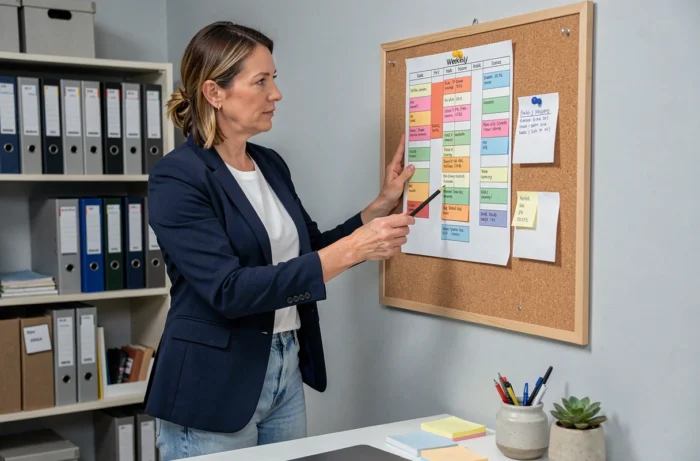
Most online advice offers organizational tools: to-do lists, family schedules, management apps. These tools structure tasks, but they do not decrease the volume of decisions to be made. The person filling out the list remains the one carrying the cognitive load.
A more effective approach is to automate repetitive choices. Setting a rotating menu for two weeks eliminates the daily question of what to eat. Assigning a fixed day for each type of household task (Monday laundry, Wednesday bathroom) removes the micro-decision of “when to do what”.
Resources like trucs-de-nana.be compile practical tips that go in this direction, focusing on directly applicable solutions rather than general principles.
The other lever concerns the explicit sharing of mental load within the household. Delegating a task is not enough: responsibility for thinking about that task must also be transferred. Assigning children’s medical appointments to a partner means they also handle reminders, prescriptions, and follow-ups, without needing to check.

Women’s daily routine: the back-to-school trap
The family situation weighs heavily on personal time. Women with children, especially single mothers, are significantly more likely to report not being able to preserve moments for themselves. The back-to-school period amplifies this phenomenon: new activities to schedule, supplies, parent-teacher meetings, adjusting schedules.
The back-to-school season acts as a seasonal peak of mental load. Three strategies can help limit the impact:
- Negotiate the distribution of roles before the start of the school year, not during. A discussion in August about who manages sports registrations, who handles Wednesday transport, avoids ongoing adjustments in September.
- Prepare a reusable back-to-school routine from year to year: standard supply list, weekly planning template, already compiled administrative contacts.
- Integrate a daily micro-ritual of recovery lasting fifteen minutes, sanctified in the schedule just like a sports class or a medical appointment.
This last point is not trivial. A protected quarter of an hour each day produces measurable effects on perceived stress, provided it is non-negotiable.
Stress and family life: distinguishing physical fatigue from cognitive overload
Women aged 25 to 44, particularly in households with children, are overrepresented among those reporting high levels of stress. The temptation is to respond with physical rest: sleeping more, doing yoga, taking a bath. These responses address bodily fatigue, not cognitive overload.
The stress related to mental load is decision-making stress, not muscular stress. It manifests as difficulty “turning off” the brain in the evening, nighttime awakenings related to organizational thoughts, and disproportionate irritability over minor details.
To address this type of stress, the levers are different:
- Externalize thoughts onto a single medium (notebook, app) and forbid revisiting them before a defined time slot. The problem is not forgetting, it’s ruminating.
- Reduce digital solicitations related to home and family: disable notifications from parent groups, limit checking school messaging to once a day.
- Identify “ghost tasks,” those we do without realizing it (checking the toilet paper stock, thinking about a classmate’s birthday gift). Listing them makes them visible and therefore shareable.
Physical activity and women’s well-being: moving without adding a constraint
Adding a workout three times a week to an already saturated schedule creates additional pressure. Abandonment usually follows within a few weeks. Integrating physical activity into existing travel works better than a separate program.
Getting off a bus stop early, walking to pick up the children from school instead of driving, always taking the stairs: these adjustments require no additional organization and no childcare arrangements.
For women who want a more structured practice, yoga or brisk walking offers a good benefit/constraint ratio. These activities require neither expensive equipment nor a subscription, and can be practiced at home or outdoors, even with a child in a stroller for walking.
Active recovery rather than performance
The goal is not physical performance but stress regulation. Ten minutes of stretching in the evening, done regularly, provide more benefits than an hour of running done once a month. The regularity of a micro-practice surpasses the intensity of a one-time effort.
Household chores themselves constitute a physical activity often underestimated. Vacuuming, hanging laundry, tidying a room significantly mobilize the body. Recognizing this effort as real, rather than as “non-sport,” also contributes to a more accurate view of women’s daily energy expenditure.
Making life easier for women on a daily basis does not rely on yet another organizational tip, but on the ability to make visible the invisible work and redistribute its shares. Tools and routines only serve if they effectively reduce the number of decisions carried by a single person.