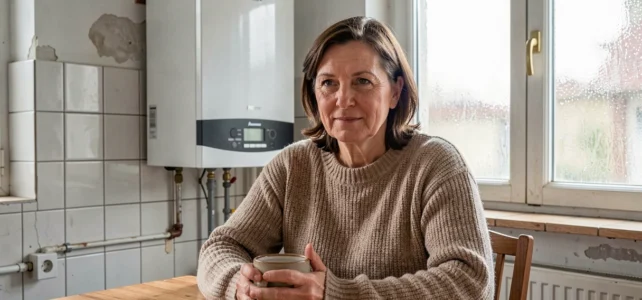
In Brussels, thousands of tenants and homeowners observe the same paradox: the boiler is new or recent, the flame ignites without issue, and yet some rooms remain lukewarm, or even downright cold. The causes almost always go beyond the appliance itself. Between the boiler and the radiator, a complete technical chain conditions the transfer of heat, and each link can silently degrade the overall performance of the home.
Faulty hydraulic circuit: the cause that the heating technician doesn’t always investigate
A recent condensing boiler produces hot water at the programmed temperature. But if this water does not circulate properly in the network, the heat never reaches the emitters. The problem then lies downstream of the generator.
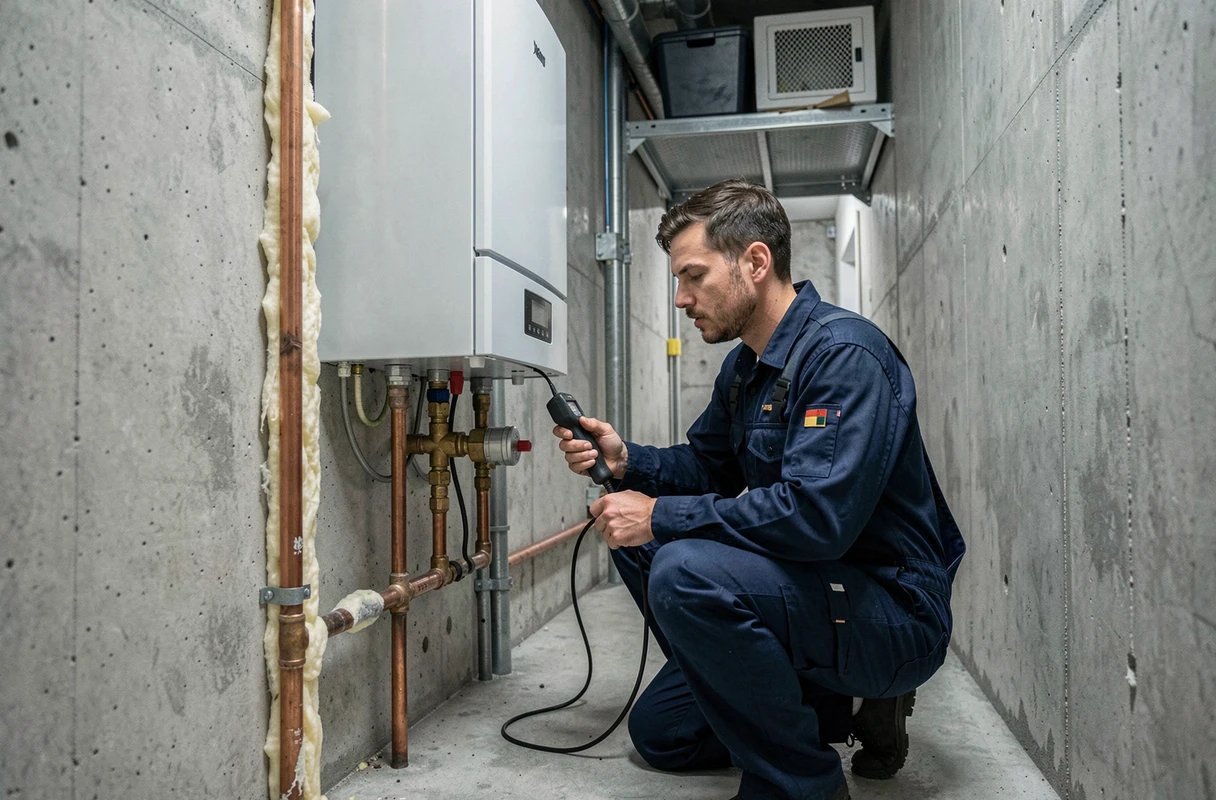
The circulator (the pump that pushes water through the pipes) may operate at an insufficient flow rate, run at an inappropriate speed, or show signs of wear without completely breaking down. In older Brussels buildings, where the risers serve several floors, a hydraulic imbalance between apartments leads to uneven distribution: apartments close to the boiler room receive too much flow, while those at the end of the circuit receive too little.
Among the common causes of hydraulic blockage is the three-way valve stuck in the intermediate position. This component directs water either to the heating circuit or to the production of domestic hot water. When it gets stuck, the boiler appears to operate normally, but the heat goes in the wrong direction.
Some poorly heated Brussels homes accumulate several of these malfunctions without any being serious enough to trigger an error on the boiler, complicating diagnosis.
Sludge and scaling: the slow degradation that no one sees
Central heating systems age from the inside. Over the years, sludge (iron oxides, corrosion residues) settles in the radiators and piping. This phenomenon, known as sludge buildup, gradually reduces the effective cross-section of the conduits and the heat exchange surface of the radiators.
A sludge-filled radiator remains cold at the bottom while the top is warm, or heats only on one side. Replacing the boiler does not solve anything if the distribution network remains loaded with sludge. A chemical or mechanical desludging of the circuit is then the only effective solution.
On the boiler side, the heat exchanger can become scaled if the network water is hard, which is common in several Brussels municipalities. A scaled exchanger transfers heat to the circuit water less effectively. The burner compensates by running longer, the energy bill increases, but the temperature in the rooms stagnates.
- Sludge in the radiators: manifests as localized cold spots on one or more emitters, unrelated to the boiler’s power.
- Scaling of the exchanger: causes a slow temperature rise and excessive gas or oil consumption, often mistaken for a tuning issue.
- Clogged filters and strainers: reduce water flow without causing a shutdown, making the symptom difficult to detect without differential pressure measurement.
Poorly configured regulation settings on a recent boiler
Homegrade, the renovation advice center for the Brussels Region, reports that the heating curve is often poorly set during the initial installation. This curve determines the water’s departure temperature based on the outside temperature. If it is too low, the radiators never heat sufficiently to compensate for the building’s heat losses.
If the curve is too high, condensation no longer occurs and efficiency drops. Thermostatic valves pose a similar problem. In many homes, they are set arbitrarily or remain stuck after a summer of non-use. A radiator with a thermostatic valve stuck in the closed position simply will not receive hot water, regardless of the boiler’s power.
Bleeding the radiators, often presented as a trivial act, also plays a concrete role. Air trapped in the circuit prevents water from filling the entire surface of the emitter. In a multi-level building, the radiators located on the upper floors are the most exposed to this problem.
Insulation and old buildings: when the boiler compensates for a thermal sinkhole
In Brussels neighborhoods built before the 1970s, walls often lack any insulation. Single-glazed windows, uninsulated cellar floors, and north-facing walls create cold surfaces that absorb heat faster than the system can produce it.
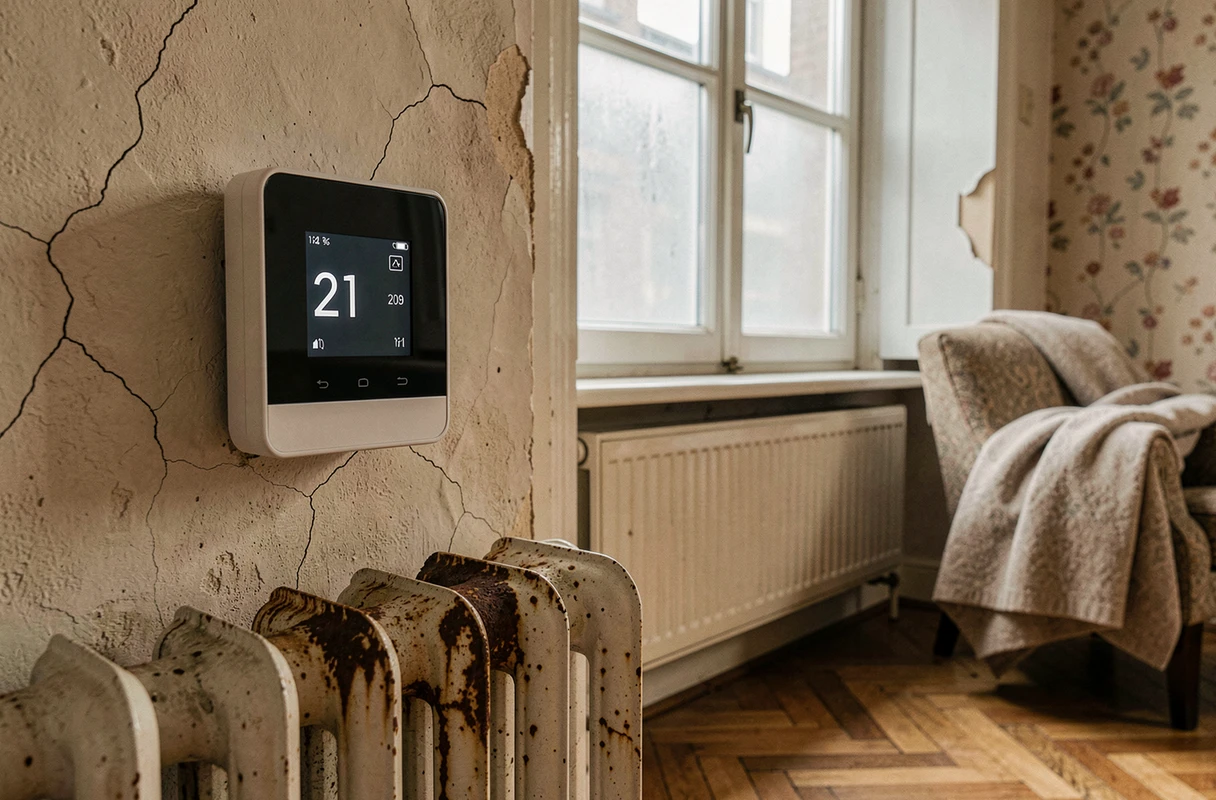
The feeling of cold does not always come from a low air temperature. A room may register 20 °C on the thermometer and still feel cold if the surrounding walls are at 12 or 13 °C. This cold wall phenomenon is particularly pronounced in Brussels buildings with solid brick walls.
Installing a high-performance condensing boiler in a building whose envelope has not been improved is akin to heating a volume that leaks from everywhere. The boiler may be perfectly sized for an insulated home but end up undersized for a structure whose actual thermal losses exceed theoretical calculations.
Humidity and thermal bridges in Brussels
Humidity exacerbates the situation. A damp wall conducts heat more quickly than a dry wall, accelerating losses. Thermal bridges (wall-floor junctions, lintels, window frames) concentrate losses and promote condensation, which in turn maintains humidity.
Some occupants reduce their heating setting to limit the energy bill, which keeps the home in a temperature zone where relative humidity remains high. The cycle is difficult to break without intervention on the building itself.
Global diagnosis rather than isolated replacement
The tendency to replace the boiler as a first reflex in response to a thermal comfort issue overlooks the majority of the real causes. A diagnosis that is limited to the generator ignores the circuit, regulation, building envelope, and usage.
- Check the flow and pressure of the circulator, not just the boiler pressure.
- Measure the return water temperature: a gap that is too small between supply and return indicates a flow or sludge problem.
- Compare the programmed heating curve to the actual losses of the home, taking into account existing insulation.
- Bleed and check each thermostatic valve at the beginning of the season, not just the radiators that seem cold.
A Brussels home that remains cold despite a recent boiler sends a clear signal: the problem lies between the generator and the walls. As long as the circuit, regulation, and envelope are not examined together, replacing the boiler alone will not correct the comfort defect.