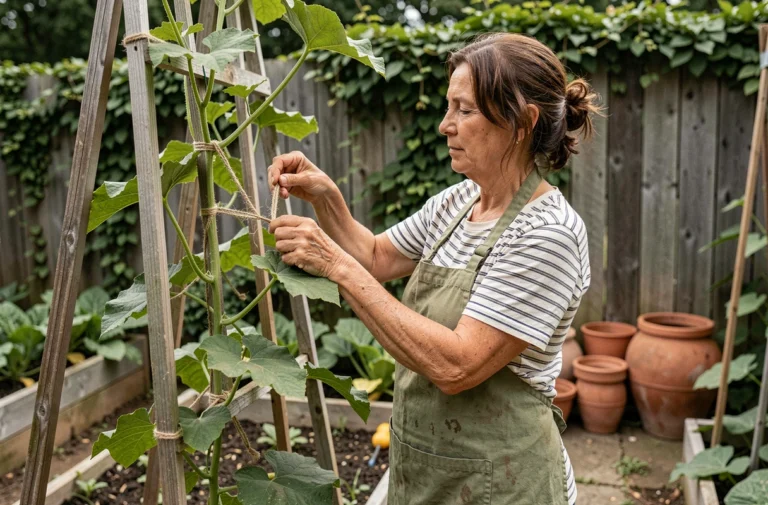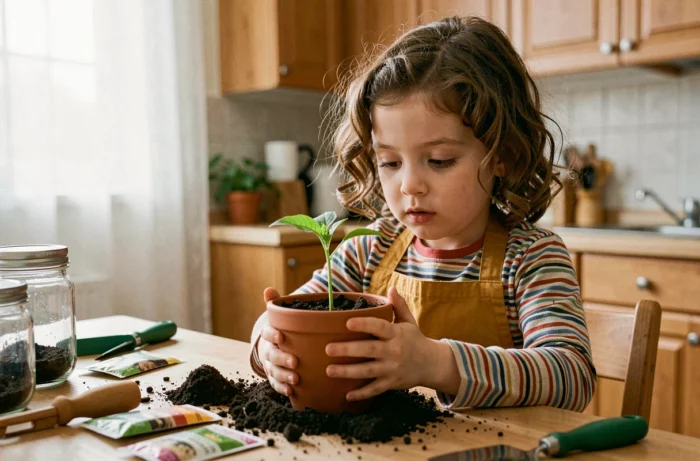
A four-year-old child taking apart an alarm clock on the kitchen table is not misbehaving; he is conducting an investigation. Starting from this natural reflex to propose fun and educational activities that are appropriate transforms every afternoon into a learning ground. The challenge is not to multiply the proposals but to choose those that are sustainable and create a real spark.
Epistemic curiosity in children: what recent research changes
Curiosity is often discussed as a personality trait. Recent studies conducted at the University of Chicago provide clearer insights. Researchers studied children aged 3 to 6 using a protocol called the “Animal Game,” designed to measure epistemic curiosity.
This test distinguishes between two behaviors: the search for novelty (the child prefers what he does not know) and knowledge-oriented curiosity (the child explicitly wants to “know more”). The scores obtained are associated with better learning outcomes in preschool.
For us, in practice, this means that an activity that encourages a child to ask questions and seek explanations is more valuable than an activity that passively entertains them. We can use this as a filter to sort the proposals we make at home or in a community setting.
Resources like the Excargot website for children gather materials that align with this approach, focusing on active exploration rather than content consumption.
Building games and scientific experiments to learn by doing
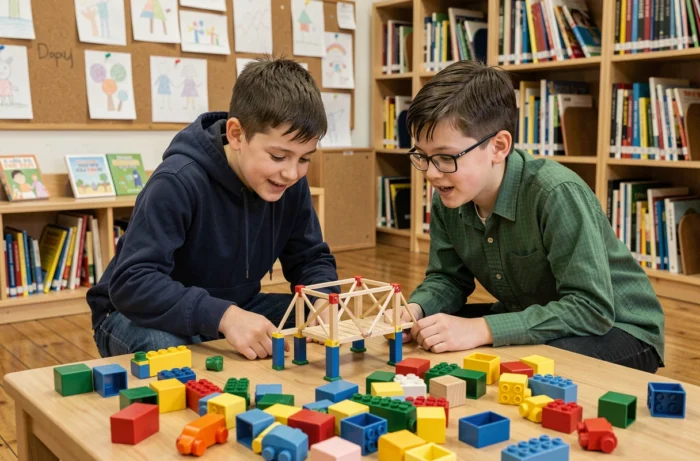
A cup, vinegar, baking soda: the resulting chemical reaction captivates a five-year-old for a good fifteen minutes. This type of simple experiment engages observation, hypothesis formulation, and surprise at the outcome. It is the foundation of the scientific approach, without needing to say the word.
Building games operate on a similar principle. Assembling pieces to create a stable structure requires anticipating, correcting, and starting over. Errors become a normal step in the process, not a failure. This aspect is important for the child’s confidence in their own abilities.
In France, the preschool curriculum includes curiosity among the objectives of the “Exploring the World” domain. STEM (science, technology, engineering, mathematics) activities are therefore not reserved for extracurricular workshops. They can be replicated at home with common materials.
Some experiments that work well at home
- Growing lentils in damp cotton to observe the germination cycle over a week, noting changes each day in a small notebook.
- Building a marble run with toilet paper rolls and tape, testing different inclines to understand the concept of slope.
- Mixing food coloring in water to discover secondary colors, then drawing the resulting mixture.
- Making a phone with two cups and a stretched string to explore sound transmission.
Feedback varies on this point: some children immediately engage with physical experiments, while others prefer activities related to living things (plants, insects). Observing what captures their attention allows for adjustments without forcing.
Nature activities and field trips to awaken the senses
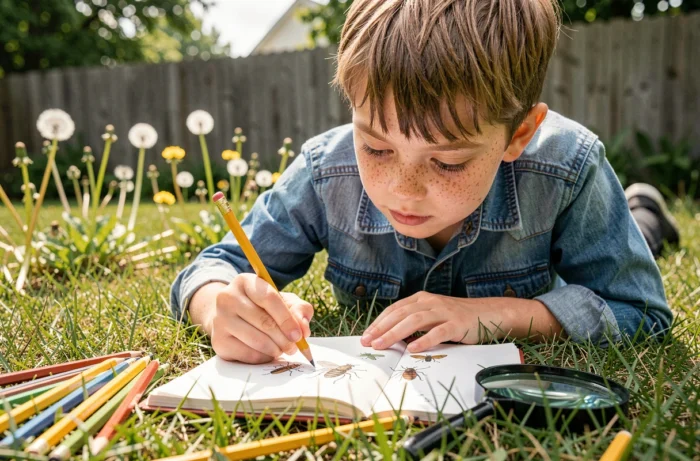
Taking a child to a park or forest with a specific mission transforms a mundane walk into an exploration. You can ask them to collect five different leaves and then sort them by size or shape once back home. This simple action engages touch, sight, descriptive vocabulary, and logical reasoning.
Direct contact with nature develops sensory curiosity in a way that digital resources cannot replicate. Handling soil, listening to a bird’s song, feeling damp moss: each stimulus triggers spontaneous questions.
You don’t need to live in the countryside. A community garden, a compost bin in a schoolyard, or even a balcony with a few pots is sufficient. The key is consistency. A child who observes the same plant each week will eventually notice details they would never have seen otherwise.
Books and field notebooks to extend observation
Pairing an outing with a written resource reinforces memorization. A notebook where the child draws what they have seen, even clumsily, forces them to look closely. Age-appropriate documentary books complement the experience by naming what they have observed.
This back-and-forth between the field and the book creates a virtuous cycle: observation feeds reading, and reading guides the next outing. This principle is found in French school programs, where science education relies on alternating between direct experience and structuring knowledge.
Screens and children’s curiosity: setting a framework that works
The question of screens is framed in terms of usage, not prohibition. A longitudinal study published in 2026 (following a decade, ABCD cohort) shows that among adolescents, moderate screen time is associated with better cognitive abilities. The problem lies with passive and unstructured usage.
For children aged 1 to 6, the data is clearer: screen time at this age leaves a measurable impact on later academic results. Working memory and language skills appear particularly sensitive to unaccompanied early exposure.
Three levers can help frame this usage on a daily basis:
- Prioritize interactive content (educational apps where the child takes action) over passive videos.
- Limit screen time for those under six and compensate with hands-on or outdoor activities.
- Watch with the child and discuss what is happening on screen, to transform consumption into exchange.
A screen used as a starting point (a video about volcanoes before making a salt dough model) is more valuable than a screen used as a babysitter.
Awakening a child’s curiosity does not require a budget or a complex program. A cup of vinegar, a trip to the park, a notebook, and a pencil already cover a good part of the ground. What makes the difference is the consistency of proposals and the attention given to the questions the child asks, even when they come at inconvenient times.