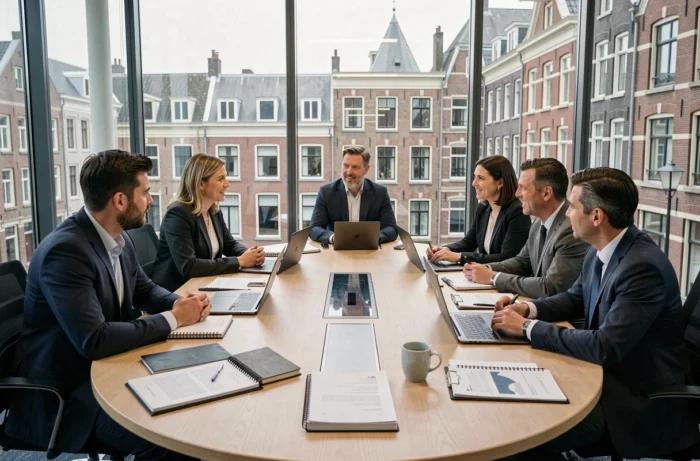
The format of a professional meeting in Belgium is decided before choosing the location or the agenda. Organizing effective meetings first requires making decisions about the decision-making mechanics, the hierarchical level truly necessary around the table, and the expected deliverable at the end of the session. Without these decisions, the rest is merely logistics.
Decision Level and Pre-Meeting Framing for a Professional Meeting
A meeting that leads to nothing is often one where the participants present do not have the mandate to decide. We observe this pattern in the majority of Belgian organizations, whether they are SMEs or associative structures.
Pre-meeting framing involves defining three elements before sending out any invitations: the type of decision to be made (validation, arbitration, brainstorming), the exact scope of the subject, and the list of people whose presence is necessary for the decision to be effective.
Confusing a top-down information meeting with a co-construction session generates frustration. We recommend specifying the nature of the meeting directly in the subject line of the invitation. A structured agenda in blocks of fifteen to twenty minutes, each linked to a deliverable (minutes, action plan, budget arbitration), reduces the time spent in the meeting by about a third, according to feedback we collect from our clients in Wallonia and Brussels.
Specialized platforms for organizing seminars and corporate meetings, such as those found on discoverymeeting.be, facilitate this step by offering venues suited to the chosen format, which avoids the frequent mismatch between the meeting’s objective and the room’s configuration.
In-Person Meetings in Belgium: Why the Return to Physical Changes the Game
The Befimmo/IVOX barometer of 2026 reveals that one third of Belgian employees no longer wish to telecommute, an increase compared to the previous year. Remote meetings are considered tiring and less satisfying, even by young workers aged 18 to 34, who are comfortable with digital tools.
This data has a direct consequence on the organization of corporate seminars. For high-stakes topics (project launch, strategic plan, conflict resolution), in-person remains the format that generates the most trust and creativity. Remote meetings still have their relevance for short and tightly framed follow-up points, but they do not replace the quality of exchange found in a well-prepared physical meeting.
In practice, this means that investing in an appropriate meeting venue is not an ancillary expense. The physical setting directly influences employee engagement and the quality of decisions made.
Choosing the Seminar Venue: Often Overlooked Technical Criteria
Most articles on the subject limit themselves to geographical location and price. We find that logistical failures often stem from poorly evaluated technical criteria in advance.
- Acoustics and modular configuration: a U-shaped room is suitable for a discussion-oriented meeting of ten people but becomes counterproductive beyond twenty participants. Check the possibility of reconfiguring the space into sub-groups without moving all the furniture.
- Network connectivity: the shared Wi-Fi of a hotel is not sufficient for a video conference with remote colleagues. Demand a dedicated bandwidth or an accessible wired network in the room.
- Natural light and ventilation: beyond two hours of meeting, a room without windows causes a measurable drop in attention. Seminar venues in Belgium that offer direct access to an outdoor space (terrace, garden) allow for active breaks that rejuvenate the team’s concentration.
- Integrated catering: outsourcing lunch breaks extends the day and fragments the group. A venue that offers on-site catering simplifies logistics and maintains collective dynamics.

Meeting Times and Duration: The Belgian Legal Framework to Consider
Belgian regulations on working hours and workplace well-being impose constraints that organizers often underestimate. Meeting times must respect the availability slots defined by company agreements, especially in structures that apply the right to disconnect.
Planning a seminar that runs into the evening without prior agreement exposes the company to disputes. We recommend scheduling strategic meetings for a maximum of four hours, with a break every ninety minutes. This rhythm corresponds to available data on sustained attention capacity in a professional context.
For mixed teams (Belgian employees and cross-border workers), the issue of cross-border telecommuting and the European social security framework agreement can also influence the choice between in-person and remote. A physical seminar in Belgium avoids administrative complications related to exceeding telecommuting thresholds for French or Luxembourgish cross-border workers.
Facilitation and Team Engagement During a Seminar
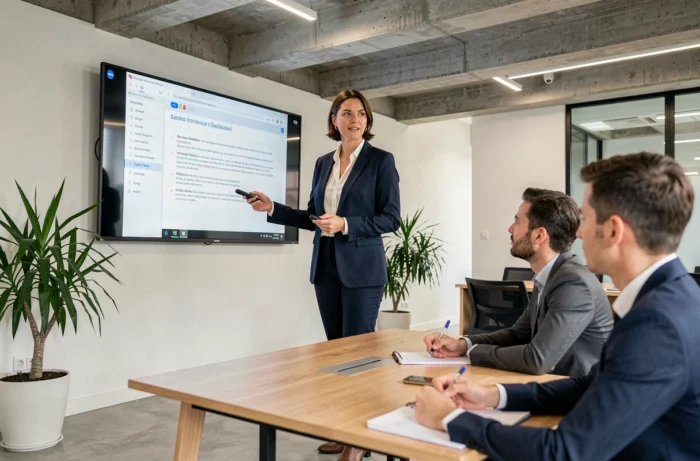
Facilitating a corporate meeting is not limited to a slideshow followed by a roundtable. The format conditions the quality of contributions much more than the oratory talent of the facilitator.
Three concrete principles consistently work:
- Alternate formats every thirty minutes (presentation, pair work, collective feedback) to maintain attention.
- Assign an active role to each participant before the meeting (rapporteur, challenger, timekeeper). A passive participant for two hours retains almost nothing from the session.
- Conclude each block with a written decision visible to all. A whiteboard or a shared document in real-time is sufficient. The absence of written records is the primary cause of meetings that repeat without progress.
The choice of a seminar venue that offers differentiated workspaces (plenary room, sub-committee rooms, informal space) facilitates these alternations without wasting time.
Organizing effective professional meetings in Belgium relies on precise technical decisions, not on generic recipes. Decision framing, choosing a venue suited to the actual format of the session, and respecting the attention rhythm of employees are the three levers that distinguish a productive meeting from a meeting endured.