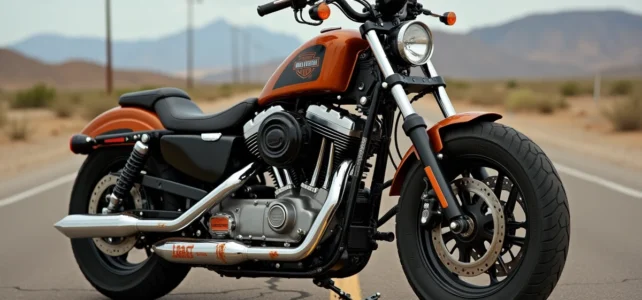
On a a Dyna or a Road Glide loaded for a weekend, the Twin Cam 103 ci runs smoothly for hundreds of kilometers without faltering. Then one morning, at idle, a tapping noise appears, or the timing chain tensioner makes its presence known. The Harley 103 ci engine divides owners because its performance depends as much on the year of manufacture as on what is asked of it on a daily basis.
Twin Cam 103: the model years that change everything
We often talk about the 103 as a unique engine, but there is a real break between the early versions released in 2011 and those produced from around 2014 onwards. The latest generation 103s are considered the most refined in the Twin Cam family: more reliable pressed crankshaft, improved lubrication, revised compensator, and on certain touring models, the introduction of Twin-Cooled cooling.
The 2011-2013 versions carry more teething issues. Reports mention weaknesses in the timing chain tensioner and rocker noises sometimes before reaching 40,000 kilometers. The later model years, on the other hand, regularly exceed 150,000 kilometers without heavy intervention.
When evaluating the reliability of the Harley 103 ci engine, this distinction of model year is the first filter to apply, whether for a used purchase or to anticipate a maintenance program.
Reprogramming and Stage 1 on the 103 ci: real impact on longevity
Stage 1 (open air filter, free-flow exhaust, ECM reprogramming) is almost standard in the Harley community. On the 103, this modification radically changes the character of the engine. Torque increases, and the throttle response becomes sharper.
The issue does not come from Stage 1 itself, but from the quality of the reprogramming. A recent testimony on a Road King illustrates the trap well: after installing a poorly calibrated additional module, the owner experienced jerks, irregularities at idle, and degraded engine behavior. Returning to a stock mapping or going on a dynamometer with a competent mapper resolved the issue.
Three points can be noted before touching the engine management:
- Prefer a direct ECM reprogramming rather than a piggyback module, which overlays a signal instead of replacing the original tables.
- Validate the mapping on a dynamometer, especially if the exhaust and air filter were changed simultaneously.
- Monitor the cylinder head temperature after modification: a mixture that is too lean on a 103 cooled only by air causes rapid overheating in summer or in slow traffic.
Feedback varies on this point, but a clean reprogramming seems to have no negative effect on the longevity of the engine, while a rough adjustment prematurely wears the valves and rings.
Maintenance of the Harley 103 engine: the actions that make a difference
The Twin Cam 103 shares its basic architecture with the 96 ci, and both engines require the same seriousness in maintenance. The difference is that the 103 handles mileage better as long as nothing is neglected.
Engine oil and oil change intervals
Harley Davidson recommends relatively spaced oil change intervals. In practice, shortening oil changes to 5,000 or 6,000 kilometers improves crankshaft protection, especially in summer use or when carrying a passenger. The 103 engine naturally consumes a bit of oil; this is normal for an air-cooled V-twin. Excessive consumption (more than half a liter between two oil changes) points to a problem with valve guides or rings.
Timing chain tensioner and compensator
These are the two components that come up most often in negative feedback. The hydraulic timing chain tensioner can weaken and cause a characteristic rattle when cold. On 103s before 2014, some owners replace the hydraulic tensioner with a mechanical one to permanently eliminate the issue.
The compensator (torque damper on the primary transmission) also makes itself known with a metallic noise at startup or at idle. Reinforced compensator kits solve the problem, but the part and labor represent a significant budget.
Harley 103 ci used: what to check before buying
In the used market, a 103 ci can be found at very varied mileages. The engine can run for a long time, but a few checks can prevent acquiring someone else’s problems.
- Listen to the engine when cold: a rattle that disappears after a few minutes indicates a tired tensioner. A noise that persists when hot signals play in the rockers or a deeper issue.
- Check the history of oil changes and the brand of oil used. An engine fed with suitable oil (20W50 synthetic, for example) ages better than a block serviced with generic oil.
- Ask if the motorcycle has received a Stage 1 or 2, and especially demand the details of the reprogramming. A stage without validated mapping is a red flag.
- Inspect the base gasket of the cylinders. An oil trace at the base of the cylinder on a 103 is not dramatic, but it is a negotiation point.
A well-maintained 103 ci with a readable history remains a reliable motorcycle over time. The engine handles long trips, two-up riding, and even daily use without major issues, as long as maintenance intervals are respected and modifications are not piled on without coherence.
The Twin Cam 103 does not have the sophistication of the Milwaukee-Eight that succeeded it, but its simple mechanics make it easy to maintain oneself. For a used buyer, this is a concrete advantage: less electronics, parts available everywhere, and a community of owners documenting every intervention.