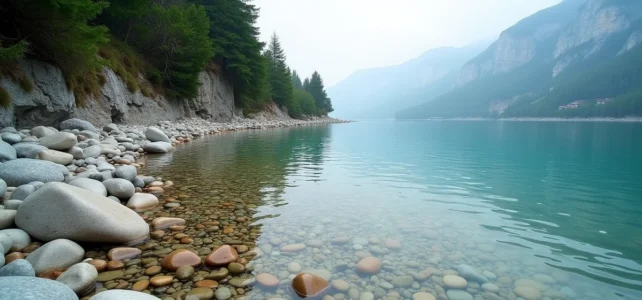
The Bourget Lake hosts about ten coves on its west bank, accessible only by water. These stretches of shoreline, wedged between the limestone cliffs of the Épine massif and the waters of the largest natural lake in France, are not found on any marked trails. Their isolation is due to the geology: the cliffs drop steeply into the lake, with no passable coastal path.
Access to the coves of Bourget Lake: boat, paddle, or nothing
The majority of articles on the subject refer to these coves as “secret” without specifying a crucial point: most are inaccessible on foot. The west bank, facing the Dent du Chat, has no continuous coastal path. The few land access points are steep, unmaintained paths, sometimes on private land.
In practice, three modes of access work. Motorboats remain the most common, departing from the Grand Port of Aix-les-Bains or the port of Conjux. Paddleboarding allows access to certain coves near the developed beaches, provided you follow the coast for several hundred meters. Kayaking offers autonomy comparable to paddleboarding, with better stability in north winds.
A comprehensive guide lists the private beaches and coves of Bourget Lake based on their mode of access, which avoids unpleasant surprises once on site.
The choice of transportation method conditions everything else: outing duration, equipment to prepare, required physical level. An inflatable paddleboard is sufficient for the coves located just a few minutes from Châtillon. To reach the most isolated spots on the west bank, a motorized vessel becomes necessary.
Navigation and anchoring regulations on Bourget Lake
Before aiming for a deserted cove, it’s essential to know the regulatory constraints of the lake. Bourget Lake enforces updated navigation rules that strictly govern anchoring.
The most stringent point concerns areas of aquatic vegetation. Anchoring is prohibited in the seagrass beds and reed beds that line part of the shoreline. These protected habitats shelter lake fauna and play a role in the natural filtration of waters. Dropping anchor in these areas exposes one to fines.
- Check the nature of the bottom before anchoring: sand or gravel is allowed, seagrass is prohibited. If in doubt, stay away from the shore and swim to the cove.
- Respect reduced speed zones near the banks, where the limit drops to a few kilometers per hour.
- Prefer a mooring buoy or a lightweight anchor on rocky bottoms to limit the impact on the substrate.
These rules are not trivial. Control patrols exist: a beach vigilance coordinating police and gendarmerie covers several sectors of the shoreline, including Conjux, Chindrieux, and Viviers-du-Lac. Officers penalize both navigation infractions and public order disturbances on the beaches.
Coves on the west bank facing the Dent du Chat: what distinguishes them
The west bank concentrates the wildest coves of the lake. Their character is due to the geology of the Épine massif, whose limestone layers plunge directly into the lake. The result: micro-beaches of white pebbles, framed by vertical walls that create shade from mid-afternoon onward.
The water quality is superior to the developed beaches on the east bank, as no urban runoff flows into them. Clarity reaches its best levels on these stretches of coast, which explains the frequent comparison to Mediterranean waters.
These coves are not all equal. Some offer a sandy bottom and a gradual entry into the water, suitable for swimming. Others present a steep rocky drop just a few meters from the shore, more suited for snorkeling than for family swimming. Depth varies unpredictably from one cove to another, and no signage indicates the conditions on site.
Differences between the east and west banks
The east bank (near Aix-les-Bains, Tresserve, Le Bourget-du-Lac) offers supervised, developed beaches, with parking and restrooms. The Mottets, Mémard, or Lido beach correspond to a classic lakeside beach experience.
The west bank offers none of this. No trash cans, no showers, no supervision. It is a wild area where each visitor assumes their own safety and leaves with their waste. This lack of facilities adds to the charm of the site, but it requires minimal preparation.
Preparing for an outing to the coves: equipment and practical constraints
An outing to the isolated coves is not improvised like a day at the municipal beach. Several elements condition the success of the experience.
- Sufficient drinking water: there are no freshwater points on the west bank. Plan for at least two liters per person for half a day.
- Sun protection and covering clothing: the reflection off the limestone cliffs amplifies UV exposure, especially between June and August.
- Waterproof bag for the phone and keys: the journey by paddle or kayak exposes equipment to splashes and falls.
- Water shoes: the limestone pebbles are sharp, and entering the water without foot protection turns each step into a trial.
For those who prefer to delegate logistics, local providers offer cruises to the coves departing from Aix-les-Bains, with a skipper and swimming equipment included. Some packages include a stop at Chanaz, which adds a heritage and gentle navigation angle complementary to swimming.
Bourget Lake remains a natural space where the weather changes quickly. A north wind can pick up in minutes and make the return by paddle difficult. Checking the lake forecasts that morning, and never leaving without communicating your itinerary to someone on land, remains the most useful precaution to enjoy these coves without incident.