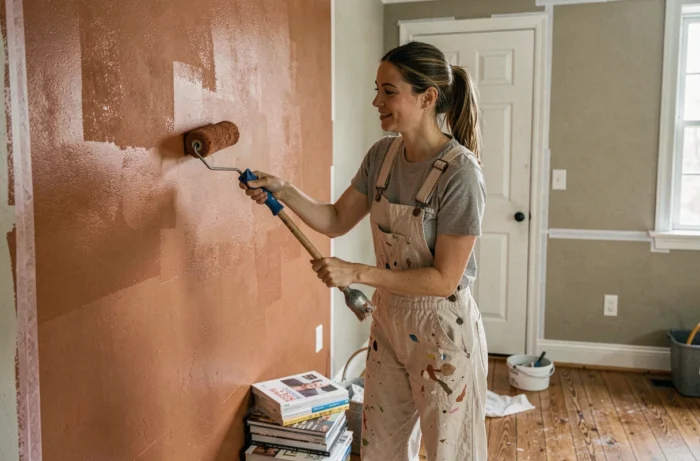
Transforming an interior does not start with the choice of a color or a piece of furniture. It begins with a technical reading of the space: volumes, circulation of natural light, proportions of openings. Without this diagnosis, every decorative decision remains cosmetic. Here, we share concrete levers that produce a noticeable change by working on finishes, materials, and color palettes that structure current trends.
Repainting interior doors: the most underestimated transformation lever
Doors represent a considerable vertical surface in every room, and most remain in standard white. Applying a bold shade to interior doors alters the perception of volumes without touching the walls.
We recommend working with satin lacquer rather than matte. Satin catches the low light and gives a taut, more polished appearance. On an old frame with moldings, a contrasting shade (emerald green, midnight blue) highlights the relief without requiring carpentry work.
To explore other approaches to renovation and interior decoration, you can access incroyablemaison.com, which brings together numerous thematic resources.
The technical key: two crossed coats over a bonding primer are sufficient on already painted wood. On raw or varnished wood, sanding with 120-grit paper followed by a blocking primer prevents tannin bleed. This project can be completed in a weekend for four to five doors.
Color palette 2025-2026: earthy colors and vivid accents
Terracotta, chocolate, and khaki shades are emerging as the new neutrals. Where gray has dominated interiors for a decade, current palettes are returning to warmer earthy tones. Khaki, in particular, works well as both wall paint and upholstery fabric.
The professional approach involves laying a earthy base on large surfaces (walls, sofa, curtains) and injecting vivid accents in small touches. Canary yellow on a cushion or a pendant light, mustard yellow on an accent chair: these pops create what trends call dopamine decor, a chromatic choice that stimulates without overwhelming.
Combining deep shades and natural light
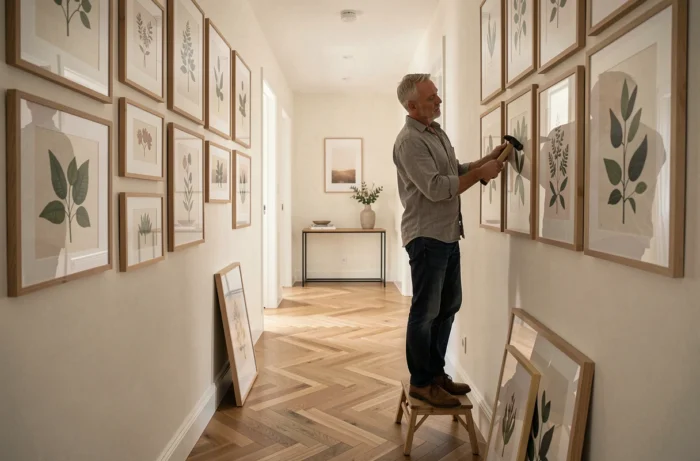
A common mistake is to reserve deep colors for large, bright rooms. In reality, a midnight blue or emerald green applied in a narrow hallway creates a sense of depth. The condition: well-oriented spot lighting (wall sconces, recessed lights) that reveals the shade instead of flattening it.
We observe that passage areas (entry, hallway, landing) are the spaces where strong color has the best effort-impact ratio. Little furniture to coordinate, reduced surface area, immediate result.
Biophilia and textiles: decorating without furnishing
Biophilia, this voluntary connection to nature in the home, goes beyond the simple accumulation of green plants. It involves working with organic materials and textures.
- Replacing synthetic curtains with washed linen or thick cotton changes the quality of filtered light and the room’s acoustics.
- Introducing rattan, raw wood, or artisanal ceramics in accessories (planters, lighting, trays) brings a visual irregularity that industrial furniture does not provide.
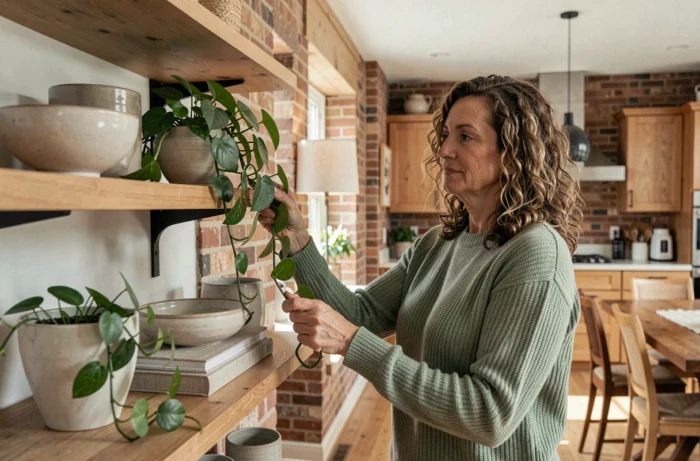
- Trailing plants (pothos, scindapsus) positioned high dress up dead corners without taking up floor space, making them suitable for small areas.
A quality textile transforms more than an additional piece of furniture. A boucle wool throw placed on a basic sofa changes the perception of the entire living room. The principle: few elements, but materials you want to touch.
Layered lighting: the technique that structures a room
Lighting remains the most neglected parameter in residential decoration. Most interiors rely on a single ceiling light, which flattens volumes and removes any visual hierarchy.
We recommend three layered lighting: ambient light (pendant or ceiling light with variable intensity), functional light (desk lamp, reading light), and accent light (directional spots on a painting, a shelf, a niche).
Color temperature and coherence
Mixing bulbs with different color temperatures in the same room creates diffuse visual discomfort. Harmonizing all sources around the same temperature (warm white for the living room and bedroom, neutral white for the kitchen) is enough to unify the atmosphere.
Replacing existing fixtures with models with integrated dimmers offers considerable flexibility. A pendant above a dining table, set to low intensity in the evening, creates a cocoon effect that a standard ceiling light cannot reproduce.
Setting up a workspace in a small area
The start of 2026 confirms the need for a work station integrated into the home, even when space is constrained. The solution does not involve an additional desk pushed against a free wall.
- A foldable wall shelf, fixed at the right height for a work surface (between 72 and 75 cm), frees up space when not in use.
- A closed wall secretary hides the visual clutter of ongoing work, preserving the decorative function of the room.
- The dead corner behind a door or under a staircase often provides the necessary depth to install a surface and a shelf above.
The choice of seating is as important as the work surface. A high stool stored under the shelf takes up less space than a rolling office chair. The space constraint forces more coherent furniture choices than those dictated by habit.
Each intervention described here shares a common point: it acts on the perception of space rather than its structure. Repainting a door, changing the lighting temperature, placing a quality textile, these actions require neither building permits nor significant budgets. The transformation of an interior relies less on the volume of work than on the precision of the choices made regarding finishes and materials.