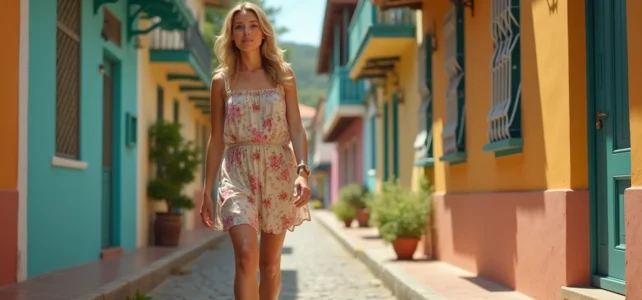
Nouméa is made up of about thirty neighborhoods spread across a peninsula bordered by the lagoon. Each has a distinct urban identity shaped by the terrain, proximity to the coast, and the city’s history. Understanding this geography allows for a coherent visiting itinerary rather than flitting between unrelated spots.
Urban planning and recent dynamics reshaping Nouméa
Before exploring the city neighborhood by neighborhood, one structural fact deserves attention. Since 2025, the Southern Province has initiated a modification of the master urban planning scheme for Nouméa, currently under public inquiry. This revision redefines buildable areas and the accommodation capacities of the agglomeration, including in the municipalities of Greater Nouméa such as Dumbéa, Païta, and Mont-Dore.
A direct consequence for visitors or future residents: real estate prices in Nouméa have been trending downwards since 2024. Neighborhoods once reserved for high budgets are becoming more accessible, redistributing the attractiveness of certain sectors. The production of housing loans remains low due to the caution of local banks, indicating that the market has not yet found its equilibrium.
To navigate among the neighborhoods of Nouméa to discover, it is essential to keep in mind this transitional period that is changing the face of several areas of the city.
Anse Vata and Baie des Citrons: the southern coastline and its distinct uses
These two neighborhoods form the nerve center of the beachside Nouméa, but confusing them would be a mistake. The Baie des Citrons is home to bars, restaurants, and a sheltered beach monitored for safety, attracting families during the day and night owls in the evening. The waterfront is dense, with terraces lining several hundred meters.
Anse Vata operates differently. The neighborhood is organized around a shopping complex focused on shopping and water sports. The beach, more exposed, attracts windsurfing and kitesurfing enthusiasts. It is also from Anse Vata that shuttles depart for Duck Island and Îlot Maître, two snorkeling spots accessible in just a few minutes by boat.
What to remember for planning a day:
- Baie des Citrons is better suited for a lunch facing the sea followed by a quiet swim, especially with children.
- Anse Vata is the logical starting point for excursions to the lagoon islets and sports activities.
- The sunset is experienced differently in each bay: terrace bar ambiance at Baie des Citrons, open view of the sea at Anse Vata.
Faubourg Blanchot and Quartier Latin: walking Nouméa
On the opposite side of the tourist coastline, Faubourg Blanchot is one of the oldest neighborhoods in the city. Its colonial houses, sloping streets, and gardens give it a calm residential character. The city of Nouméa has established a marked historical route that traces the urban evolution of the area. This route is done on foot and allows for an understanding of the architectural layers of Nouméa, from the penal colony period to modern constructions.
The Quartier Latin, despite its name borrowed from Paris, is anything but bohemian. It is a compact neighborhood close to the city center, where small shops and street vendors create a village atmosphere. There is a sense of local life that is difficult to perceive in the beach areas. It is the neighborhood best suited to feel the daily rhythm of Nouméans, away from tourist circuits.

Downtown Nouméa and market: the cultural core not to be overlooked
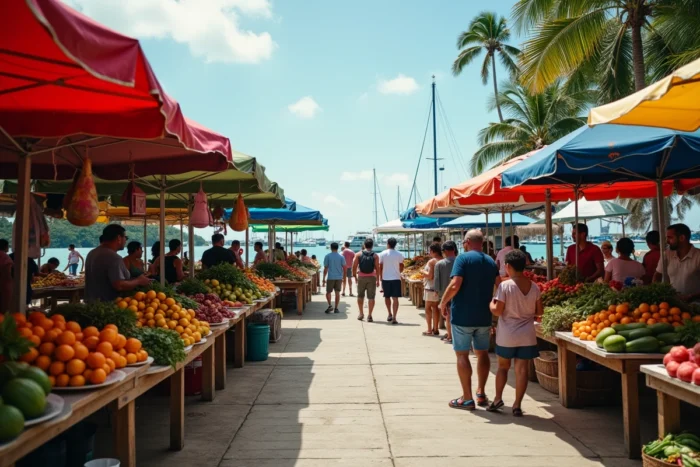
The downtown area revolves around Place des Cocotiers, Port Moselle, and its covered market. The Nouméa market is a must-visit, not as a tourist cliché, but because it reflects the culinary diversity of New Caledonia: lagoon products, tropical fruits, Melanesian, Vietnamese, and Indonesian prepared dishes.
Port Moselle accommodates pleasure boats and serves as a departure point for sea outings to the southern great lagoon. In terms of heritage, downtown houses the New Caledonia Museum and several administrative buildings dating back to the colonial period.
What distinguishes downtown Nouméa from a simple administrative district:
- The market primarily operates in the morning, with peak attendance on Sundays.
- Port Moselle offers a pedestrian promenade along the quays, pleasant in the late afternoon.
- The historical routes marked by the city allow visitors to connect points of interest in the center without a guide, thanks to signage installed on-site.
Greater Nouméa: suburban neighborhoods to consider
Dumbéa, Païta, and Mont-Dore do not technically belong to Nouméa, but they make up Greater Nouméa and host a growing share of the population. The buildings there are more recent, living spaces are more generous, and the environment is greener. The trade-off is paid in travel time to the central neighborhoods and bays.
The decline in real estate prices observed since 2024 makes these suburban municipalities more attractive for those considering a long-term move. For a visitor, they offer a glimpse into everyday Caledonian life outside the tourist perimeter, with neighborhood markets and access to natural sites less frequented than the beaches of the peninsula.
Nouméa is not just about its two famous bays. The city is best explored on foot, neighborhood by neighborhood, accepting that some areas reveal their interest only at the pace of a morning stroll or a detour through a local market. The current period of urban and real estate transition makes this exploration all the more relevant: the Nouméa of tomorrow is now taking shape in its least publicized neighborhoods.